The Concatenation
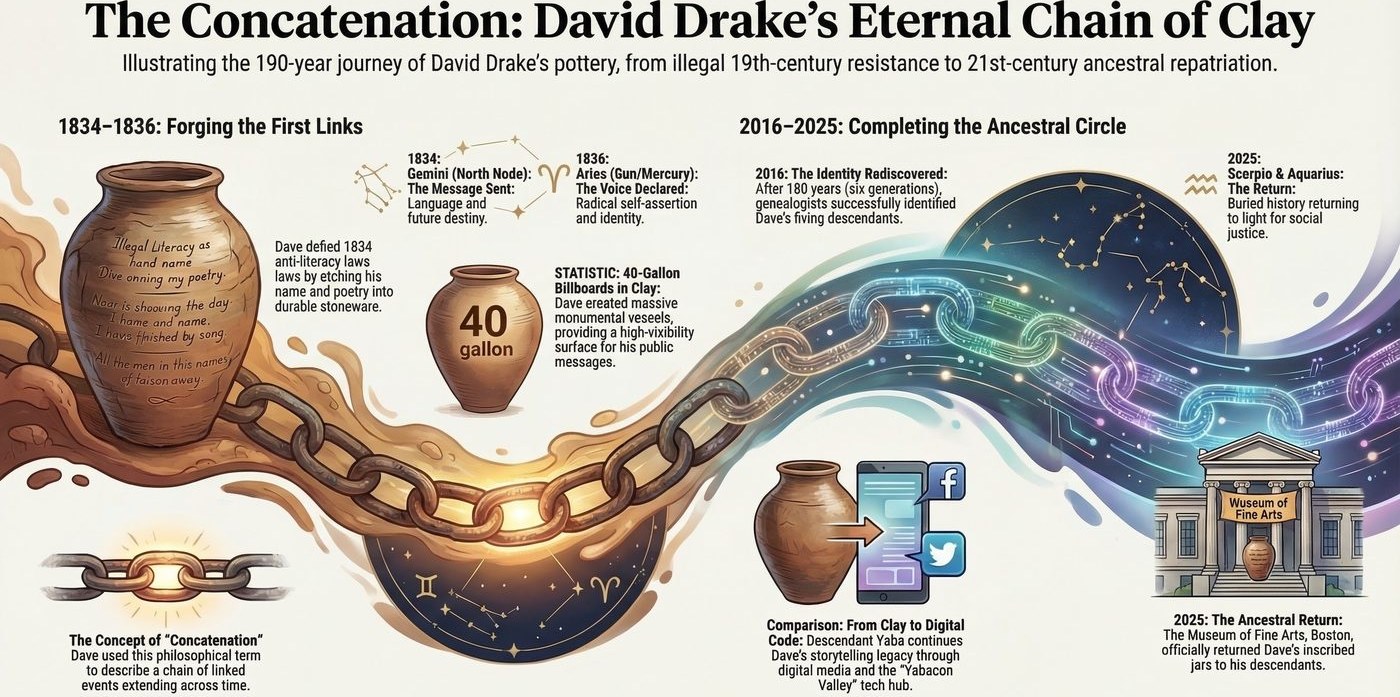
The Concatenation: A Narrative History of Dave the Potter, His Descendants, and the Long Unfinished Business of American Justice (2026).
The book is many things. It is a history of Edgefield and Aiken Counties, extracted line by line from newspapers, census records, death certificates, and court documents. It is a genealogical reconstruction of one family across five generations of American terror. It is an account of how a system of racial violence was designed, implemented, maintained, and celebrated — and of how the Edgefield Advertiser, the Aiken Standard, and the Journal and Review provided the philosophical scaffolding that made the violence feel, to the people who committed it, like civilization rather than savagery.
It is also an evidentiary record — a family's history, documented line by line.
It draws on original research from the newspaper archives, census records, death certificates, mortgage documents, NBER Working Paper 26014 (Logan), and the material culture scholarship of the Descendants of Dave Initiative.
Dave the Turner — the lineage research
The family's descent from Dave rests on the genealogical study Dave the Turner — the Dave Drake genealogy report — which assembles the documentary chain of custody from the 1818 mortgage to the living descendants.
The proof is not a single document. It is a concatenation of records, each one linking to the next:
- 1818 — The mortgage. Harvey Drake mortgages "a negro boy Dave about 17 years old" to Eldred Simkins in the Edgefield District — the ancestral anchor. See the highlighted record →
- 1847 — The Rev. John Landrum estate file. The inventory and sale bill of January 22, 1847 lists "1 Boy Dave" and "an excellent Stone Ware Turner" among the "18 likely Negroes" of the estate — placing Dave inside the Landrum–Miles pottery network whose initials mark his jars. See the highlighted record →
- 1870 — The census. David Drake, 70, "Turner," enumerated in Shaws Creek Township in the household of Mark Jones and Caroline (Miles) Jones — Dave's daughter, carrying the Miles name of his last enslaver — with the children Brister, Pierce, and Emma.
- 1926 — The death certificate. Emma Long's certificate names her parents: Mark Jones of Charleston and Caroline Miles of Aiken County — the state's own paperwork confirming the link between the generations.
- 1880–1950 — The census chain. Mark's household (1880), Emma Long's household (1900), Pierce and Willie B.'s households (1910–1930), Willie's WWI draft registration (1918), and Daisy Bell Jones Williams in Washington, D.C. (1950) — an unbroken decade-by-decade record. Follow the census journey →
From the mortgage through Caroline Miles through the Jones family to living members of Dave's lineage: an unbroken chain of custody, documented record by record.
Yaba
In a family of Emmas and Willies and Daiseys and Bookers — anglicized names, chosen or assigned within the grammar of a country that insisted on English as the language of civilization — one of the last members of Dave's documented lineage was given a name from a different tradition. Yaba. A Ghanaian name, carrying the memory of a people and a spiritual geography the Middle Passage tried to erase.
Yaba is the descendant through whom, in 2016, the family's connection to Dave was rediscovered. He is the living answer to the question Dave carved into the shoulder of a jar in the 1850s: I wonder where is all my relation.
Where the jars are
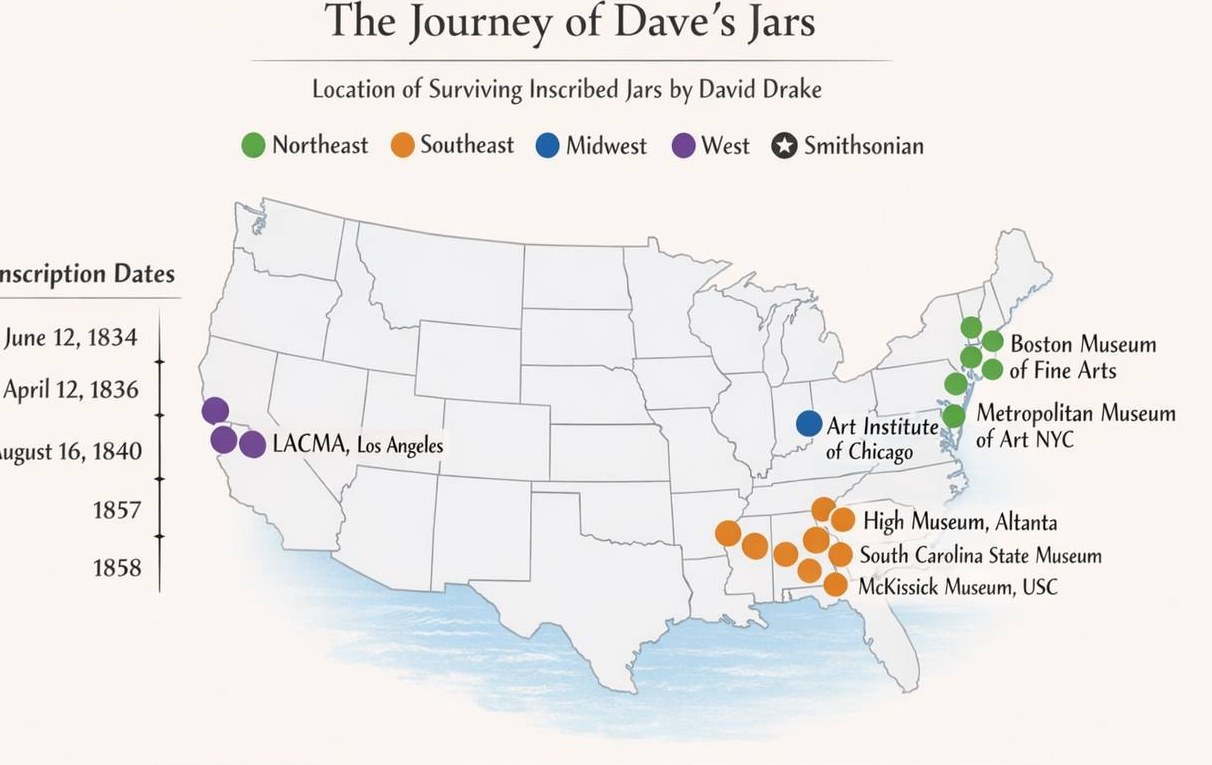
Approximately 40 to 45 of Dave's inscribed jars survive, held by the Metropolitan Museum of Art, the Museum of Fine Arts Boston, the High Museum, the Mint Museum, the South Carolina State Museum, the McKissick Museum, the Art Institute of Chicago, the Smithsonian, and others. In August 2021, one of his large, four-handled poem jars — featuring the inscription “A very Large Jar which has 4 handles / pack it full of fresh meats- then light candles” — sold at auction for $1,560,000. According to Crocker Farm Stoneware Auction, this remains the record price for any American stoneware vessel sold at auction [source]. The man who wrote those words was worth $400 in 1818. This is not irony. It is a very specific kind of American horror.
The Fine Arts Museums of San Francisco holds the Catination jar of 1836 — the second of Dave's two great philosophical inscriptions, the companion piece to Concatination, the opening movements of the chain he spent thirty years building.
The chain is not yet complete
From the 1818 mortgage to the documented descendants of today, this is one story, told in records that survived. Approximately forty-five of Dave’s inscribed jars are known to survive; the family has now located about half of them, in museums and collections across the country. The rest are still waiting to be found — exactly as Dave intended when he pressed his name into the clay.
The clay endured.
The descendants returned.The Concatenation — Epilogue