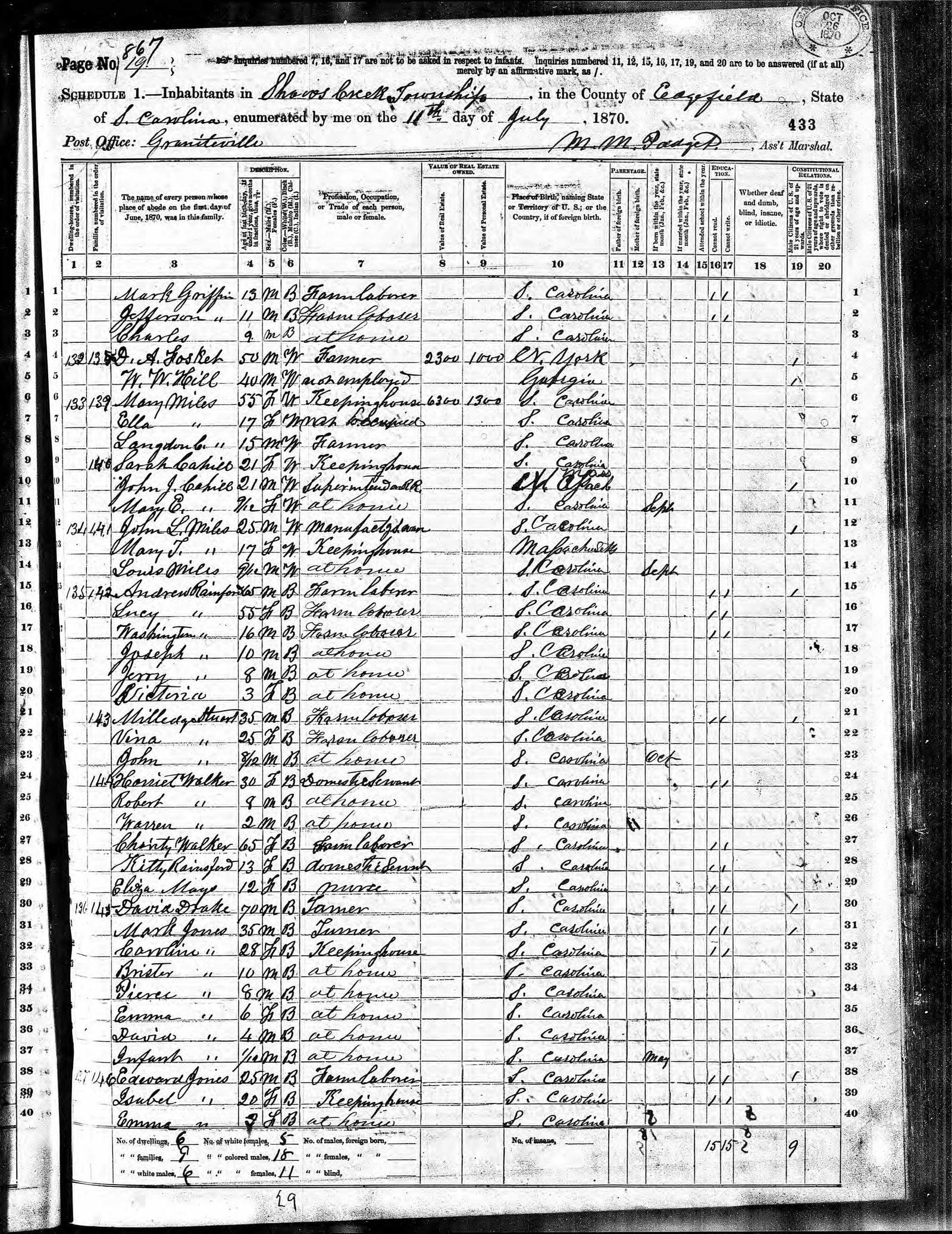
Dave, free, with his daughter's family
David Drake, 70, "Turner," lives with Mark Jones (35, turner), Caroline (Miles) Jones (28), and the children — Brister 10, Pierce 8, Emma 6, David 4, and an infant. Five years out of slavery, three generations under one roof.
The massacres Pierce watched as a boy
In July, the Hamburg Massacre: Black militia members executed after surrender. In September, the Ellenton Riot: 500–600 armed white men swept the county; estimates of Black citizens killed range from 25 to more than 100. Pierce Jones was about fourteen. He lived in Aiken County. He watched. Read Part III: The Terror at Home →
The family, without Dave
The June 1880 census finds Mark Jones, 41, farming in Shaw Township with the children — Bristol 21, Pierce 18, Emma 16, David 15, Jerry 14, and the younger ones — all recorded as "farm hands." Dave no longer appears in the record. He died sometime in the 1870s, in the same county where the Red Shirts rode.
Disfranchisement made permanent
Benjamin Tillman's 1895 constitution codified what the rifle clubs had begun — understanding clauses, poll taxes, and registrars empowered to erase the Black vote. The family's citizenship became a legal fiction, enforced by the courts of the very men who had led the rifle clubs.
Emma's household
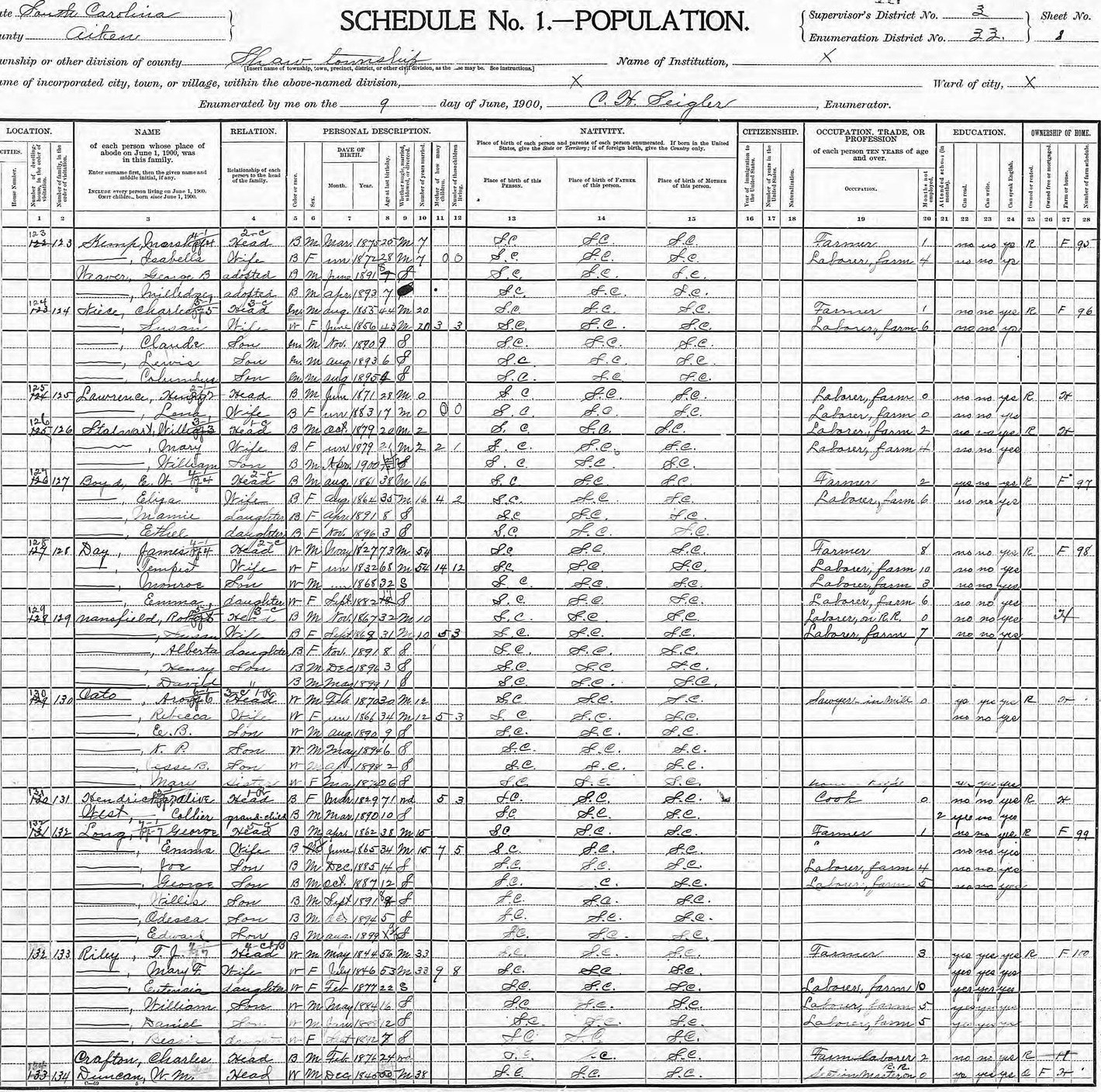
Emma — Dave's granddaughter, now Emma Long (b. June 1865) — appears with her husband George Long (farmer, b. 1862) and their sons Joe, George, Willis, Odessa, and Edward. The census records that Emma had borne seven children, five living. Neither George nor Emma could read or write: the anti-literacy world Dave defied still held their generation.
Four generations on the land
Pierce Jones, 47, heads a farm household that includes his son Willie B. Jones, 27, Willie's wife Ella, 23, and their children — Daisy Belle, 4, Booker, 3, and Eva, 1 — all recorded as farm laborers on a home farm. A large, labor-oriented family unit: an economic necessity, and a target.
Willie registers for the draft
On September 12, 1918, Willie Bristow Jones registered for the World War I draft: farming for John Morgan on Route 1, Salley, Aiken County; nearest relative, Ella Jones. The card records a tall, slender man — and preserves the family's middle name, Bristow, an echo of his uncle Brister from the 1870 household.
Willie and Ella's farm
The 1920 census records Willie Jones, general farm operator, with Ella and their children — Sylvia, Booker, Eva, Willie and the others — the household working tobacco and farm labor. The family had now farmed the same corner of South Carolina for half a century since emancipation.
The Lowman lynchings — and Emma's death
In October 1926, with the sheriff's participation, a mob dragged Bertha, Clarence, and Demmon Lowman from the county jail and shot them to death in a pine thicket. No one was ever indicted. Seven weeks later, on November 30, 1926, Emma Long died — in the same month the NAACP's Walter White was in Aiken County investigating. Read Part IV →
The family splits: stayers and leavers
In Shaw Township, Pierce Jones, 66, is recorded as the owner of his farm, living with his wife Paulina. But the younger generation has begun to leave: the 1930 census of Washington, D.C. records Daisy D. Jones, working as a cook for a private family, and Booker W. Jones, a building laborer — Willie and Ella's children, gone north after the Lowman lynchings. The Great Migration had reached the descendants of Dave.
Pierce dies where he stayed
Pierce Jones — who watched Hamburg and Ellenton as a boy and never left — died of myocarditis in 1935, in Shaw Township. A small death, a quiet death, without newspaper coverage. That he stayed and farmed and raised a family in that county was itself a form of defiance. What became of the farm he owned is an open question. See Part IV →
Daisy in the capital
Daisy Bell Jones Williams — Willie's daughter, Dave's great-great-granddaughter — appears in the 1950 Federal Census living in Washington, D.C., working as a domestic laborer, among family members working construction and domestic jobs. She carried the family's history northward like a letter that had never been opened. She almost certainly did not know that the boy mortgaged in Edgefield in 1818 was her ancestor — or that his words sat on museum shelves she would never visit.
Persistence, counted every ten years
The census was never written for this family — it recorded them as laborers, tallied their illiteracy, and misspelled their names. But read across eighty years, it becomes something the enumerators never intended: proof of a family that survived Hamburg, Ellenton, disfranchisement, the chain gang, and the pine thickets — and kept appearing, decade after decade, until the record itself carried them to freedom in the North.