Willie Bristow Jones
By 1910, Willie B. Jones — Pierce's son, Dave's great-grandson — headed a large farm-laboring household in Aiken County. He and his wife Ella raised their children — Daisey, born 1905; Booker, born 1906; Eva, born 1913 — on rented farmland in a small county with a hostile legal system.
Large Black farming families were easily targeted. The chain gang needed workers. The system was efficient. The records indicate that Willie B. Jones was sentenced to the chain gang.
We should pause and understand what that meant. The convict lease system in South Carolina — in Edgefield and Aiken Counties in particular — was not a criminal justice mechanism. It was a labor extraction mechanism that used the criminal code as its net. Black men were convicted of minor infractions — vagrancy, petty theft, breach of labor contract — and leased to private contractors who worked them under conditions indistinguishable from slavery. The Edgefield Advertiser of November 1879 noted that the state penitentiary earned over $8,000 in a single month renting out prisoners — paid by contractors who worked men to death in phosphate fields, lumber camps, and railroad beds. Men entered the chain gang and did not come out.
Willie B. Jones came home from the chain gang. He came home to a family that was becoming untenable in Aiken County. The weight of what the county had done to them — the massacres Pierce had witnessed as a boy, the disfranchisement constitution that erased their political existence, the chain gang that had taken Willie, and then, in 1926, the Lowman lynchings — all of it accumulated until leaving was the only rational response. His children Daisy and Booker appear in Washington, D.C. by 1930.
Emma (Jones) Long
Emma Jones entered the world in 1865 — the pivotal year the fire of war cooled, and the legal status of her grandfather, Dave, was transformed from asset to ancestor. She was a daughter of Caroline, a sister to Pierce, a living link in the concatenation.
She died on November 30, 1926, at the age of sixty-one — in the same month the NAACP's Walter White was in Aiken County investigating the Lowman lynchings, the murders that had taken place seven weeks earlier. The bureaucracy of the state recorded her passing with a simple, final diagnostic on a printed form: kidney trouble. The ledger records her first as a set of variables — Female. Black. Widow. — the classifications preceding her name, her age, her very life.
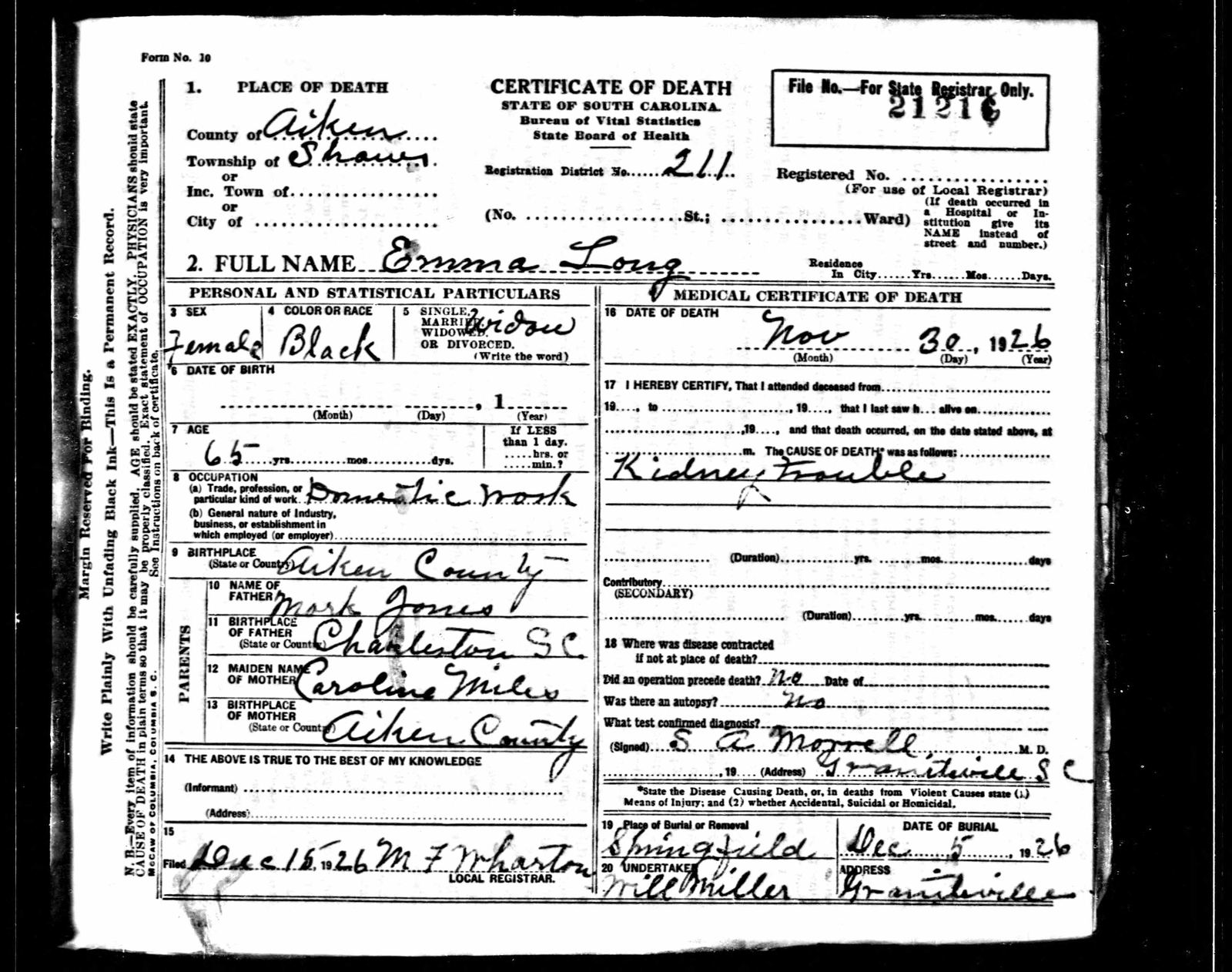
She died without knowing that her grandfather's name was being etched into museum catalogues, or that the question he asked in the 1850s — I wonder where is all my relation — was still vibrating through the air of the Edgefield district. Whatever was happening in those pine thickets, the paperwork of 1926 always found a way to say kidney trouble.
What became of Pierce's property?
Pierce Jones did not flee. He stayed. He farmed. He raised children. He lived in Shaw Township until he died of myocarditis in 1935 — a quiet death, without newspaper coverage. That he remained, under the disfranchisement constitution and the convict lease and the pine thickets, was itself a form of defiance.
And Pierce held property. The 1930 census records him, at 66, as the owner of his farm in Shaw Township — a Black man who had begun life enslaved-adjacent in the 1860s and ended it a landowner in the county of Hamburg and Ellenton. That achievement makes what follows all the more painful:
We do not know what became of the property that Pierce held.
After his death in 1935, the trail goes dark. No deed of sale, no probate distribution, no tax sale record has yet been connected to the farm. Across the South in exactly these years, Black-owned land vanished by the millions of acres — through heirs' property partition sales, tax sales conducted without notice, fraudulent conveyances, and simple intimidation. Whether Pierce's land passed to his children, was lost to the county, or was taken, is an open research question at the heart of this project.
Records that could answer it:
- Aiken County deed books and grantor/grantee indexes, 1930–1950
- Aiken County probate records for Pierce Jones (d. 1935) and Paulina Jones
- Aiken County delinquent tax sale records, 1930s–1940s
- Shaw Township plat maps and agricultural schedules
If you have information about the Jones family lands in Shaw Township, the family asks you to come forward.
The Great Silence — and the leaving
After the Lowman lynchings, the family began to leave. Between 1916 and 1970 approximately six million Black Americans left the South — because of the chain gang, the sharecropper's debt, the legal fiction their citizenship had become, and, as the records of Aiken County so clearly document, because of the pine thickets. Because of what happened when you stayed.
Daisy Bell Jones Williams carried the family's history to Washington, D.C. — folded inside her, as the book says, like a letter that had never been opened. The silence lasted for generations, while scholars wrote about "Dave the Potter" and museums acquired his jars. The family knew there had been a potter. What they could not have known — what the system was designed to prevent them from knowing — was the full scale of what he had made, and the full scale of what had been taken from them.