Violence that was calibrated, not random
Martin Witherspoon Gary — celebrated by the Edgefield Advertiser in 1878 as "Leader of the Red Shirt Democracy" — developed what he called the Shotgun Plan: kill enough Black men in strategic moments, terrorize the rest into silence, and reclaim the political power Reconstruction had briefly distributed.
Modern research (NBER Working Paper 26014) has quantified what Gary intuitively understood: for every dollar increase in per capita county tax revenue — the revenue that funded Black schools and Black civic institutions — the probability of a violent attack on a Black politician rose by more than twenty-five percent. The violence was a corrective mechanism, economic in its logic and political in its effect, designed to defund the Reconstruction state by eliminating the men who were building it.
What the family survived
The Hamburg Massacre
White rifle clubs under Matthew Calbraith Butler attacked the town's Black militia and executed its members after their surrender. Butler was later elected to the United States Senate, where he served for decades — and in 1899 told the press that Black Americans should be removed from the country, saying there was no place in the republic for the negro as a citizen. Pierce Jones, Dave's grandson, was about fourteen years old. He lived in Aiken County. He watched.
The Ellenton Riot
Between five hundred and six hundred armed white men swept through Aiken County. Estimates of Black citizens killed range from twenty-five to more than one hundred. A U.S. District Attorney described the county as under "a perfect reign of terror." Black families fled their homes and slept in the woods. The Jones family lived through it — and stayed.
"Lynch Law in Edgefield" — the killing of John Mackey and Luther Sullivan
A mob of 250 armed white men — "as completely organized as a military company," the Advertiser reported approvingly — held a "trial" in the woods, tied the two men to a pine sapling, and executed them with a firing squad of 50 to 100 men. The paper praised the mob for acting "quietly and soberly." One member of the crowd shouted, "Yes, give us blood and do it right now."
The Lowman Lynchings
After the South Carolina Supreme Court threw out their biased convictions and a judge directed an acquittal, a mob — facilitated by Sheriff Nollie Robinson, his deputies, the jailer, and a state constable — dragged Bertha, Clarence, and Demmon Lowman from their cells. Clarence was shot and dragged behind a car for a mile. Bertha, twenty-seven, was the hardest to kill; she begged for her life as they kept shooting. The NAACP identified twenty-two mob members, including the sheriff. The all-white grand jury ruled the Lowmans died "at the hands of parties unknown." No one was ever indicted.
A relative, William Cue, described what it did to the community: "Took them out of jail — drug them out like dead mules… I learned something from that… kept me from doing anything." That sentence was the point of the whole exercise. The terror was not incidental to the political project. It was the political project.
How the press made massacre sound like civilization
The Edgefield Advertiser, the Aiken Standard, and their peers provided the philosophical scaffolding that made the violence feel, to the people who committed it, like civilization rather than savagery: denying Red Shirt intimidation while the Red Shirts ringed Republican meetings; defending the "Eighth Article" and the "Mississippi Method" of disfranchisement; celebrating the convict lease that earned the state penitentiary more than $8,000 in a single month renting out prisoners; demonizing Black leadership; and campaigning to defund Black schools. The pages below are the original evidence.
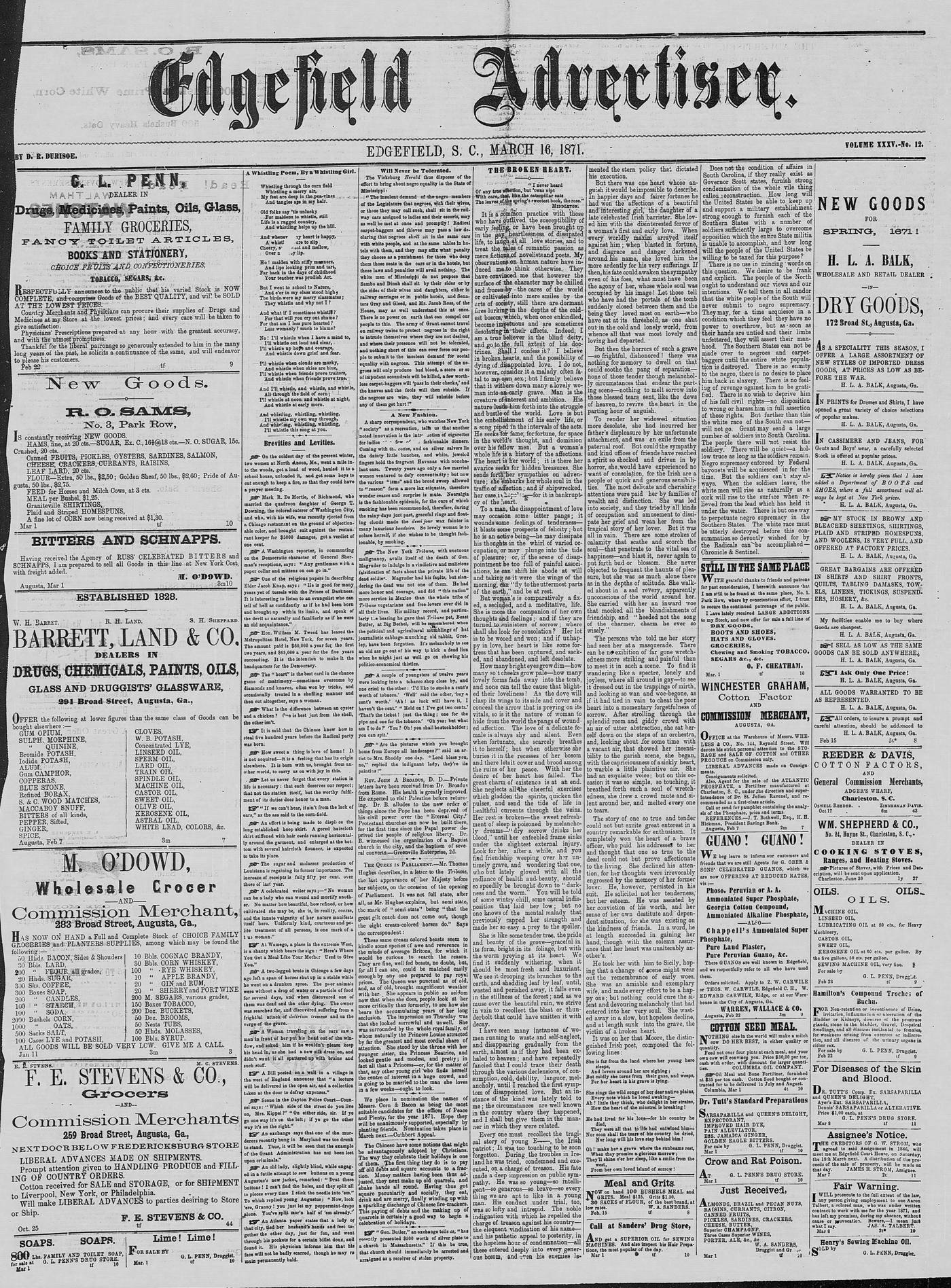
Downplaying Klan Terror
In the early 1870s the paper dismissed reports of "Ku Klux outrages" as fabrications of the "Radical press" — narrative cover for night-riding violence during the years Dave lived free with Caroline's family.
View full page →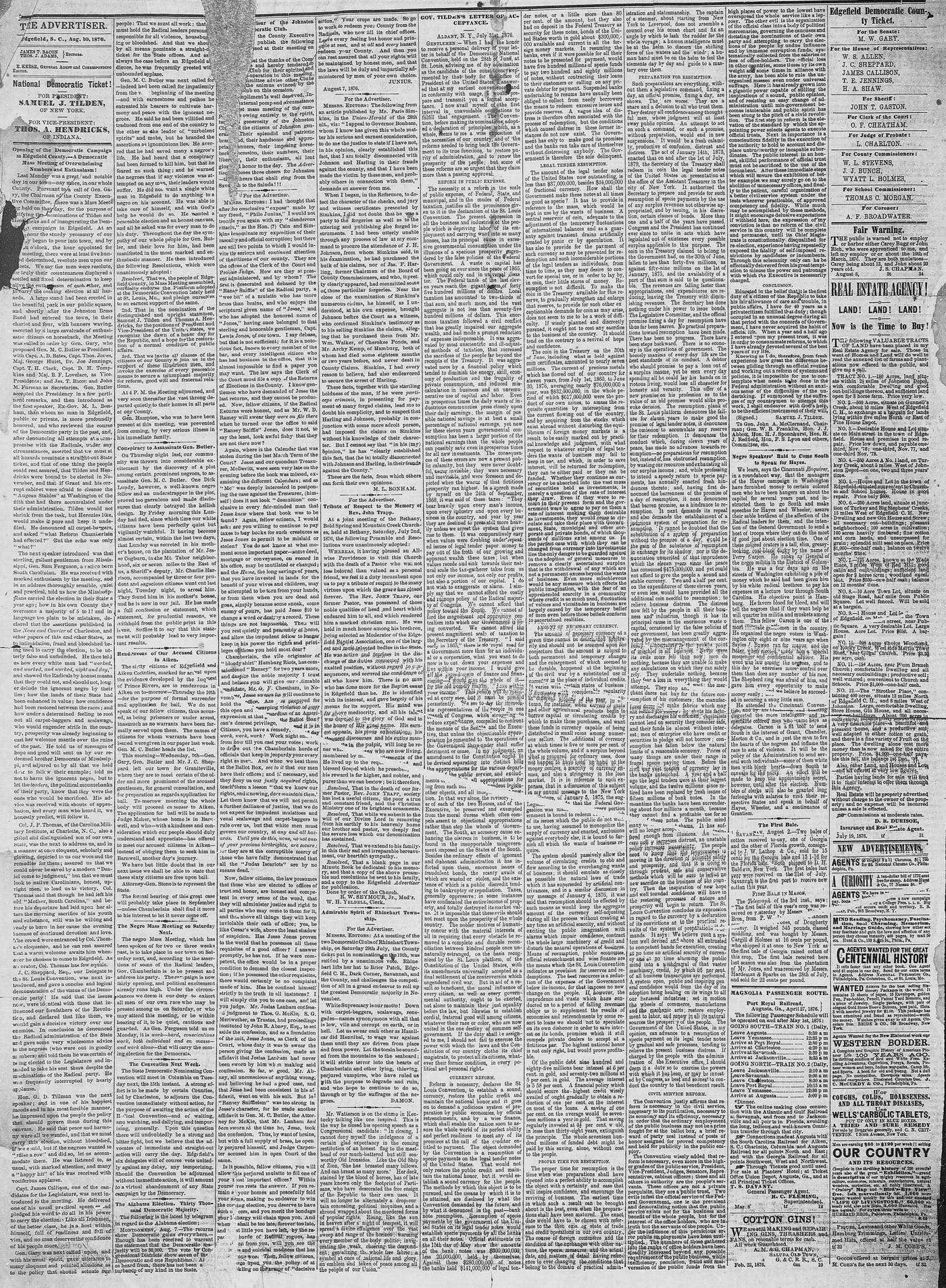
The Summer of Hamburg
Coverage from the weeks after the Hamburg Massacre, when the paper framed the killings as defensive actions and rallied the Red Shirt campaign of 1876.
View full page →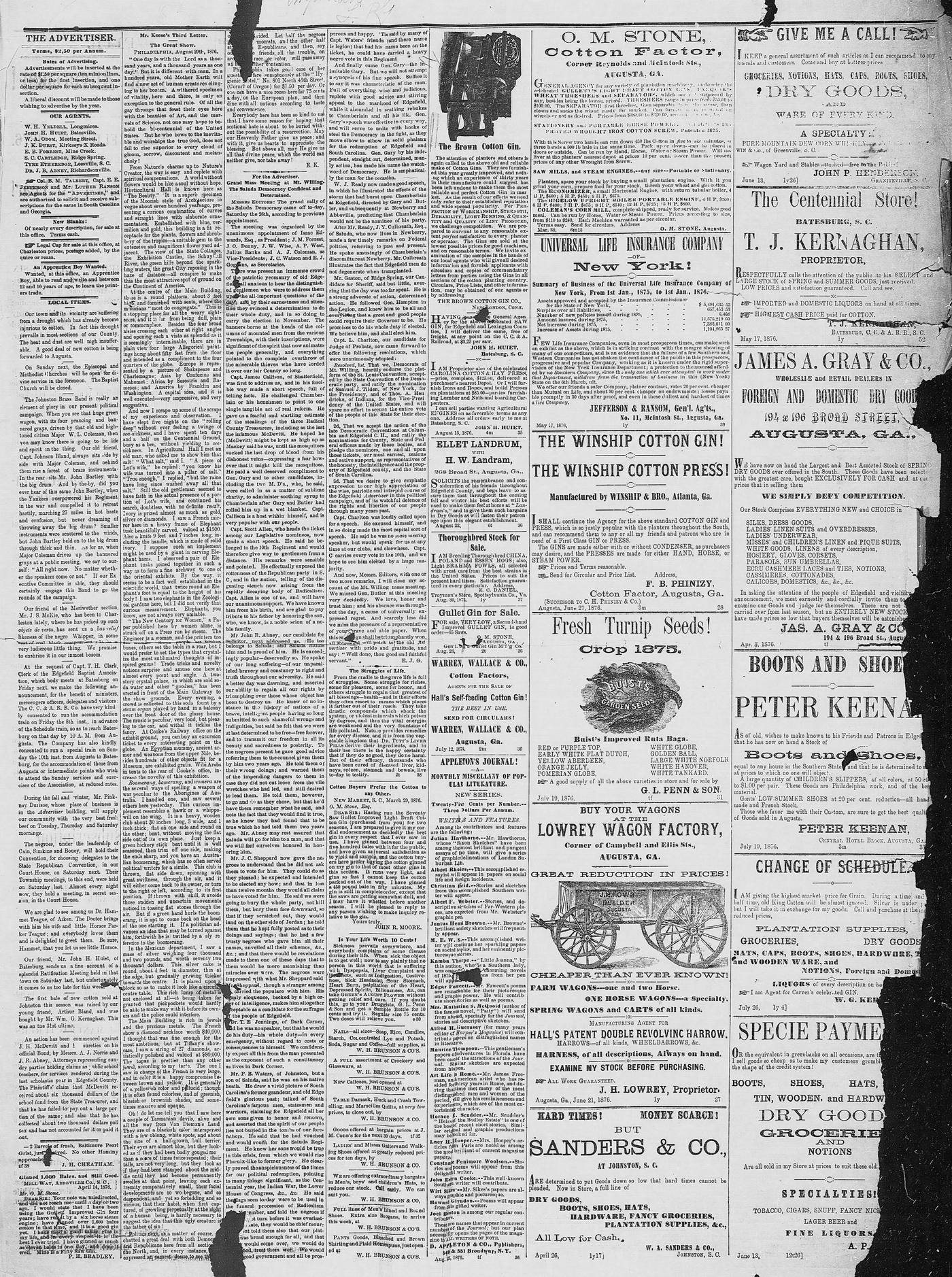
The Month of Ellenton
Printed as armed white paramilitaries swept Aiken County. The Hampton campaign's two faces — paternalistic appeals to "intelligent negroes" and mounted intimidation — fill these columns.
View full page →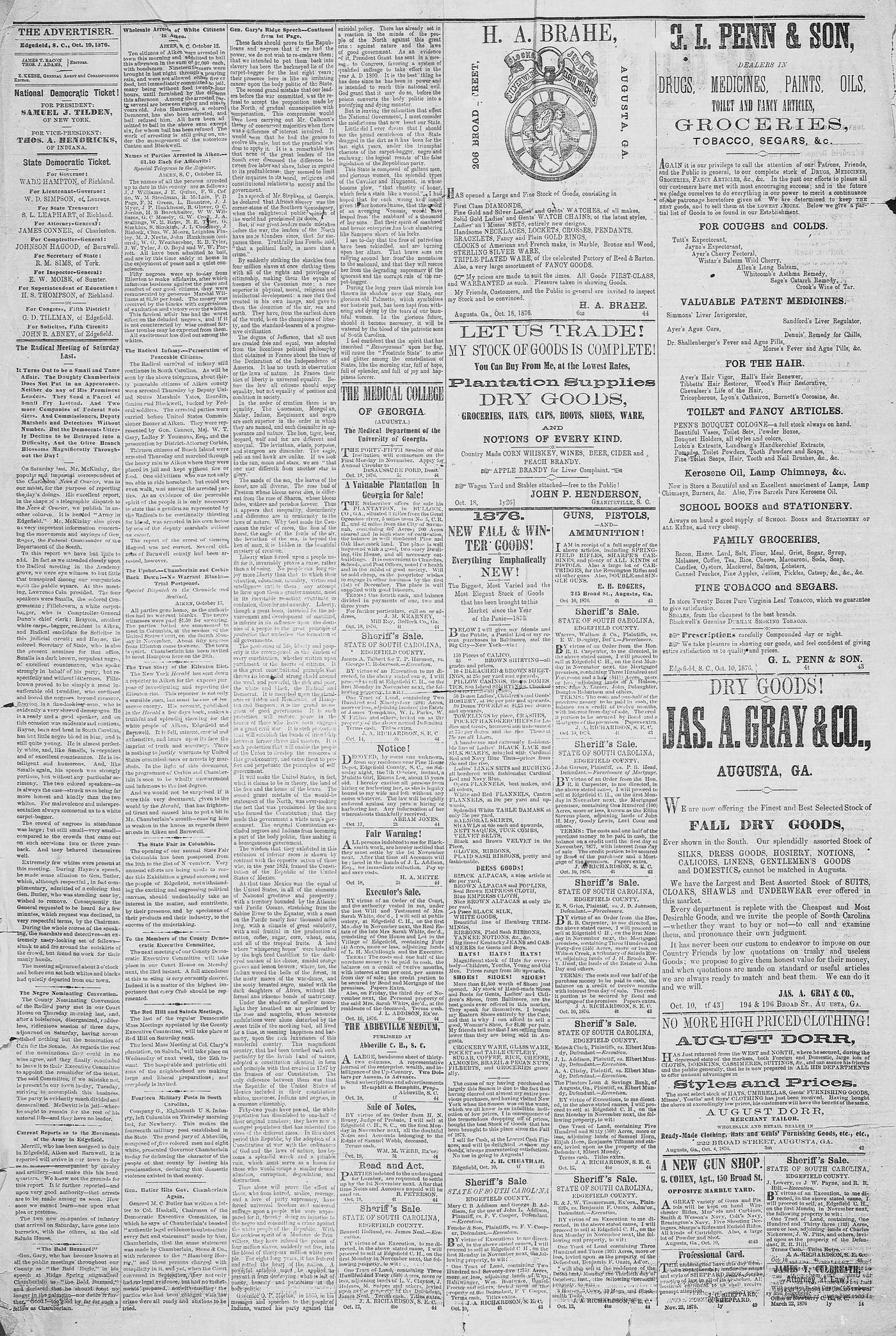
"The Red Shirts and Intimidation"
The paper's rebuttal to reports that Red Shirts had "caused the colored people of the neighborhood around Edgefield to take to the woods in terror" — claims it called "notoriously untrue."
View full page →📜 Read the articles — transcription: the paper answers Ellenton
[News items, first column]
Thirteen citizens of Beach Island were arrested Thursday and marched through the heavy rain to Aiken where they were placed in jail and kept without fire or food. One old citizen who was not only not able to ride horseback but could not even walk, was among the arrested parties. As an evidence of the peaceable spirit of the people it is only necessary to state that a gentleman represented by the Radicals to be continually thirsting for blood, was arrested in his own house by one of the deputy marshals without an escort.
The Upshot.—Chamberlain and Corbin Back Down!—No Warrant Blanks—Trial Postponed.
Special Dispatch to the Chronicle and Sentinel. — Aiken, October 13.
All parties gone home, as the authorities had no warrant blanks. The negro witnesses were paid $1.50 for swearing. The parties bailed are summoned to meet in Columbia, at the session of the United States Court, on the fourth Monday in November. About fifty negroes from Ellenton come to swear. The town is quiet. Chamberlain has been invited to meet Hampton here on the 20th.
The True Story of the Ellenton Riot.
The New York Herald has sent down a reporter to Aiken for the express purpose of investigating and reporting the Ellenton riot. This reporter is not only a sensible man, but must be one of immense energy. His account, published in the Herald a few days back, makes a truthful and splendid showing for the white people of Aiken, Edgefield and Barnwell. It is full, minute, careful and exhaustive, and bears upon its face the imprint of truth and accuracy. There is nothing to justify warrants by United States commissioners or arrests by marshals. In the light of this document, the programme of Corbin and Chamberlain is seen to be wholly unwarranted and infamous to the last degree.
And we would not be surprised if it were this very document, given to the world by the Herald, that has frightened Grant and caused him to put a bit in Mr. Chamberlain’s mouth—causing him to weaken in the knees as regards these arrests in Aiken and Barnwell.
Transcribed from the Edgefield Advertiser, October 19, 1876, page 3. Weeks after white paramilitaries killed dozens of Black citizens at Ellenton, the county’s paper covers the massacre only as a story about the injustice of arresting white suspects — the “true story” is the one that exonerates the killers, and Black witnesses are dismissed as paid swearers. This is how terror was normalized in print.
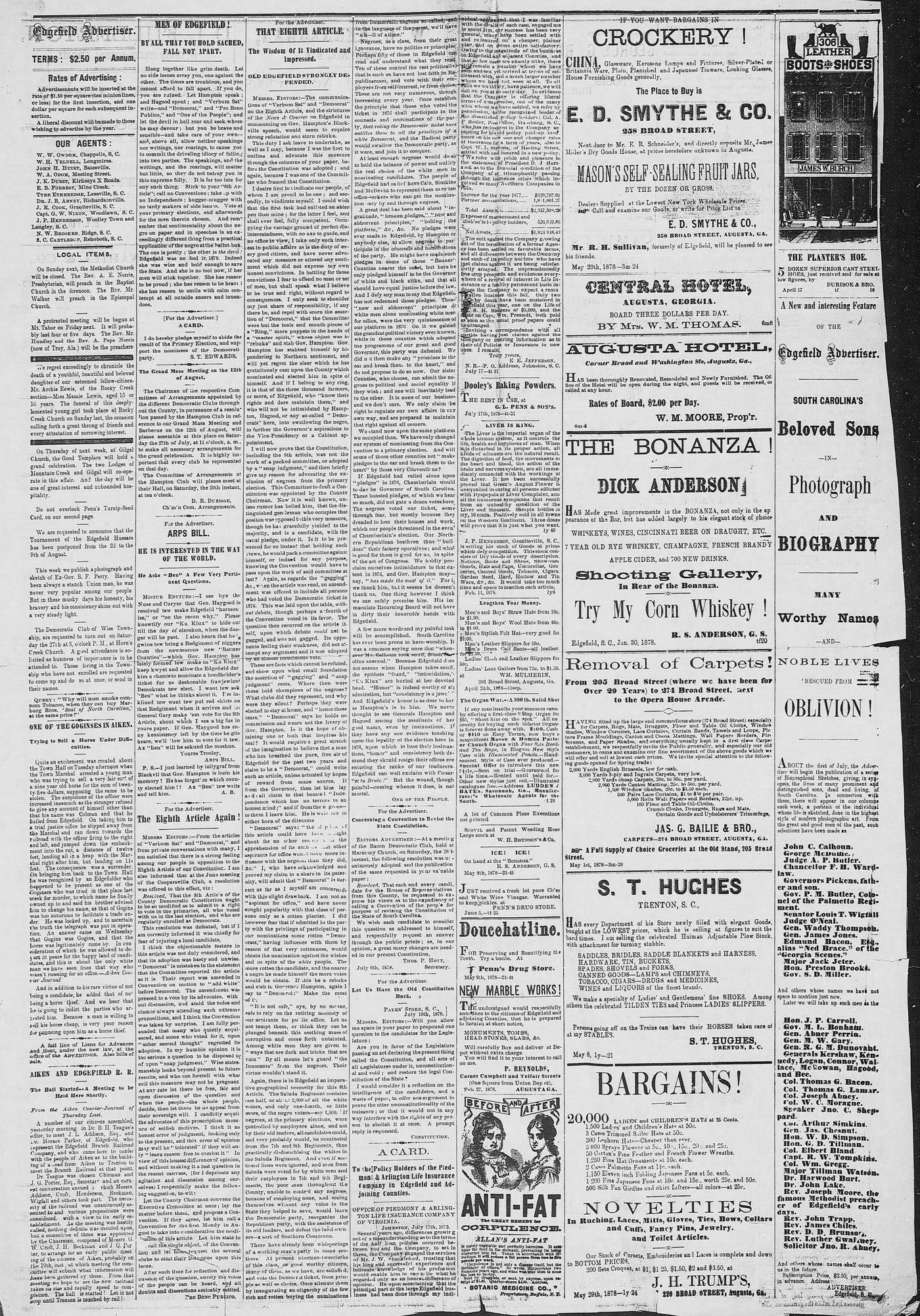
"The Eighth Article Again!"
An open defense of constitutional disfranchisement: eliminating the "negro majority" was worth sacrificing some white votes, the paper reasoned, "to save the state."
View full page →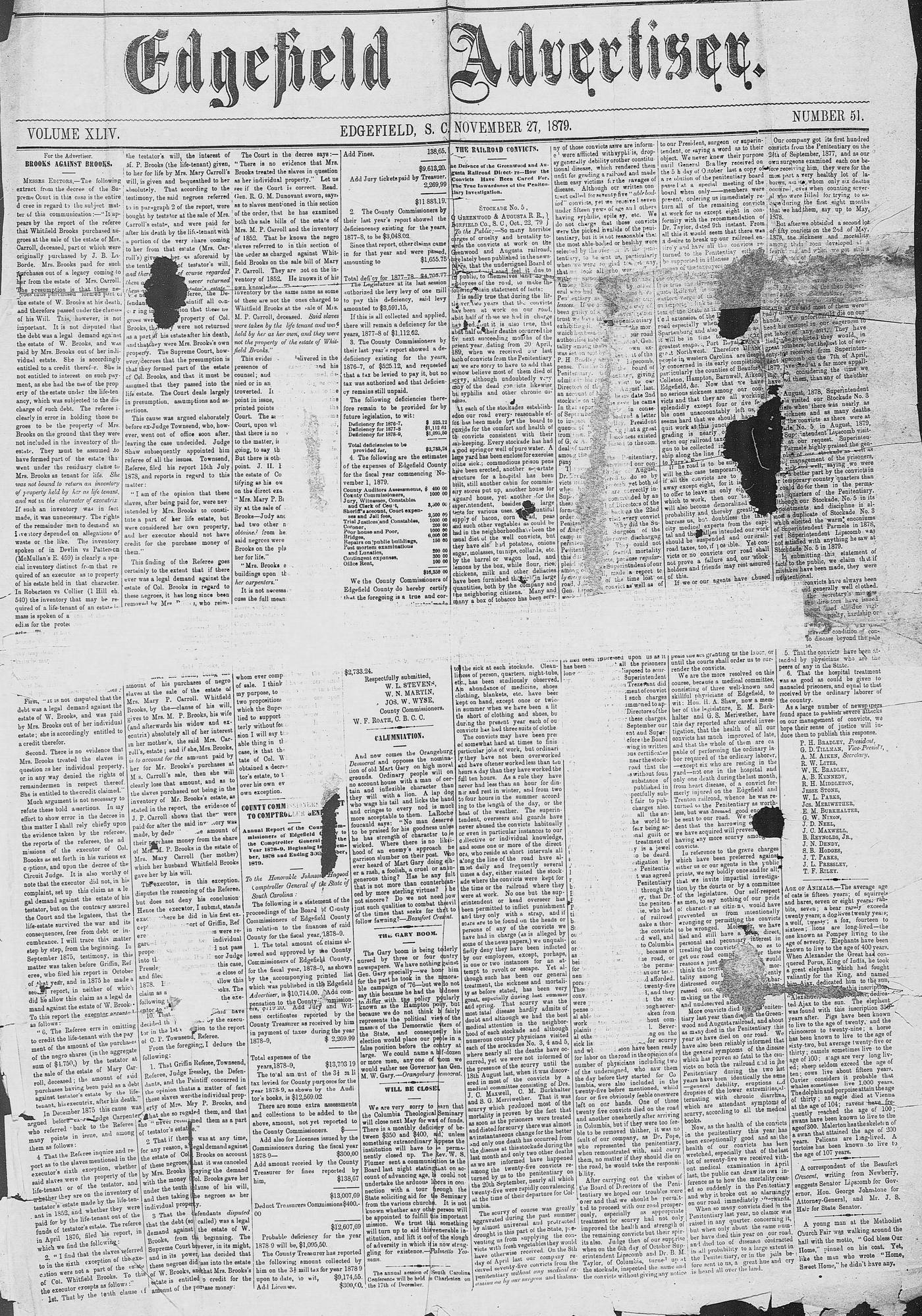
The Price of the Convict Lease
The paper noted the state penitentiary earned over $8,000 in a single month renting out prisoners — the system that would later swallow Willie B. Jones.
View full page →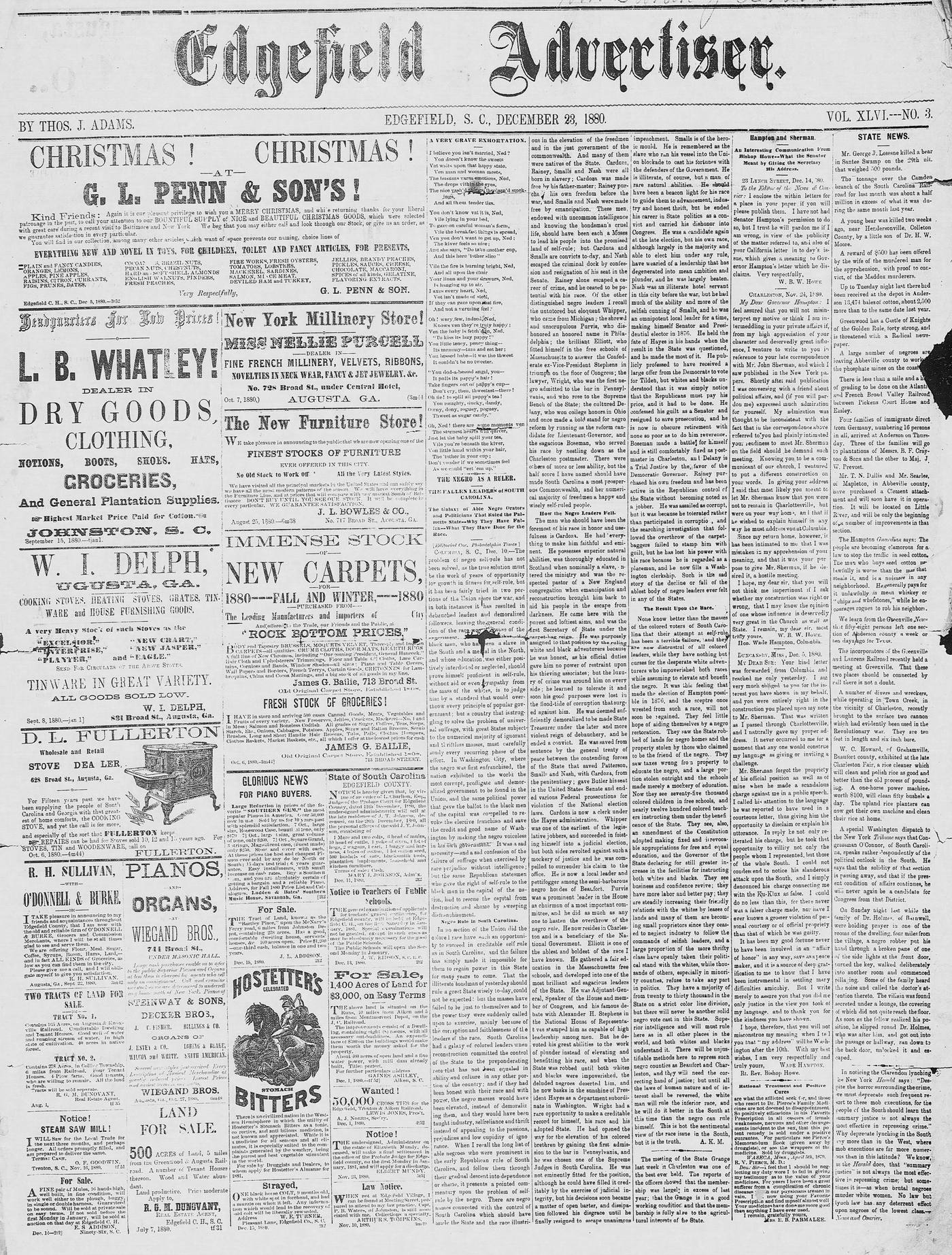
"The Negro as a Ruler"
A front-page retrospective hit piece gloating over the "fallen leaders" of Reconstruction — Cardozo, Smalls, Nash — manufacturing the memory that Black citizens were unfit to govern.
View full page →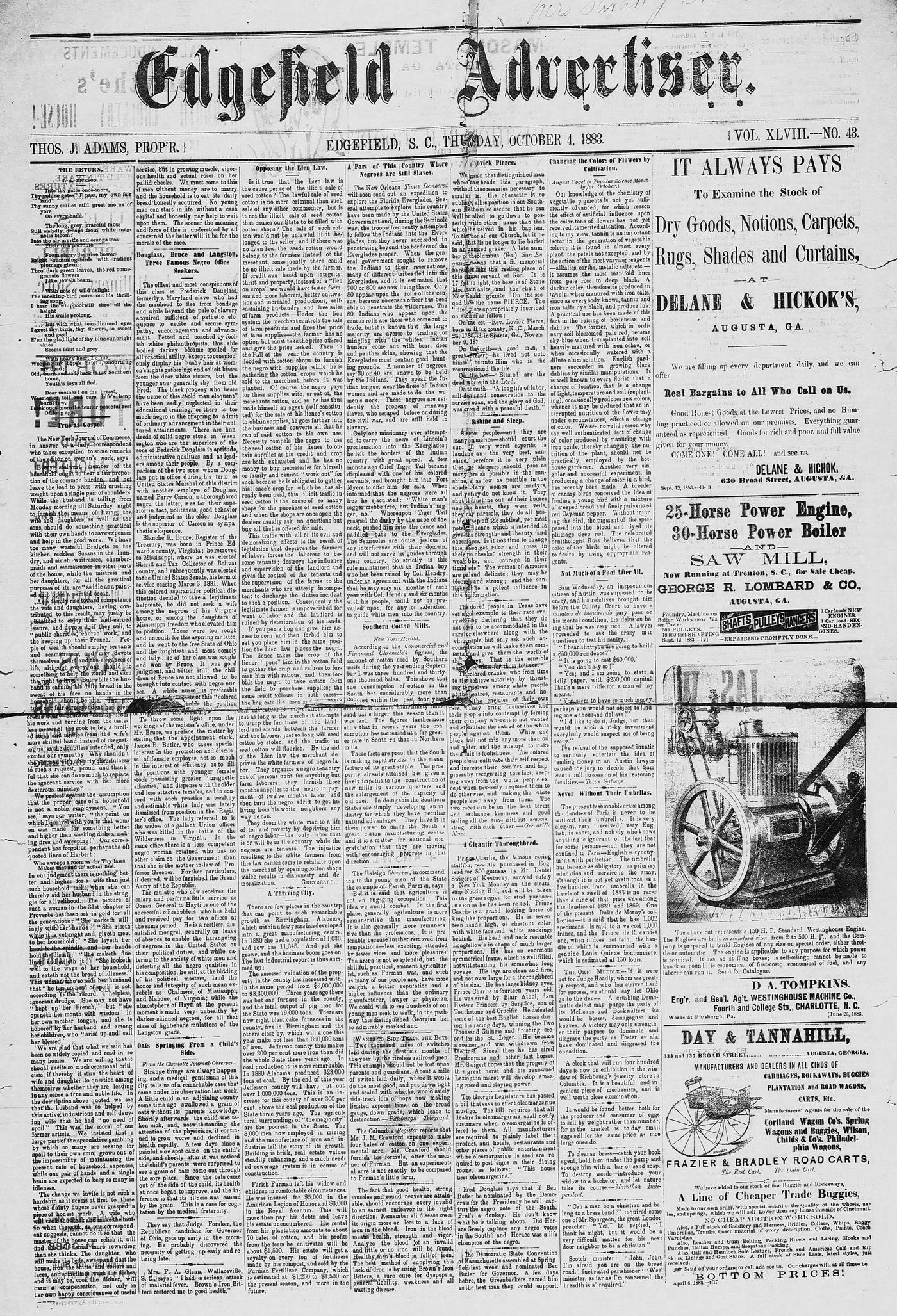
"The Black Belt in Virginia"
Imported racial paranoia: a front-page warning of the "humiliations" awaiting white society wherever Black citizens exercised political power.
View full page →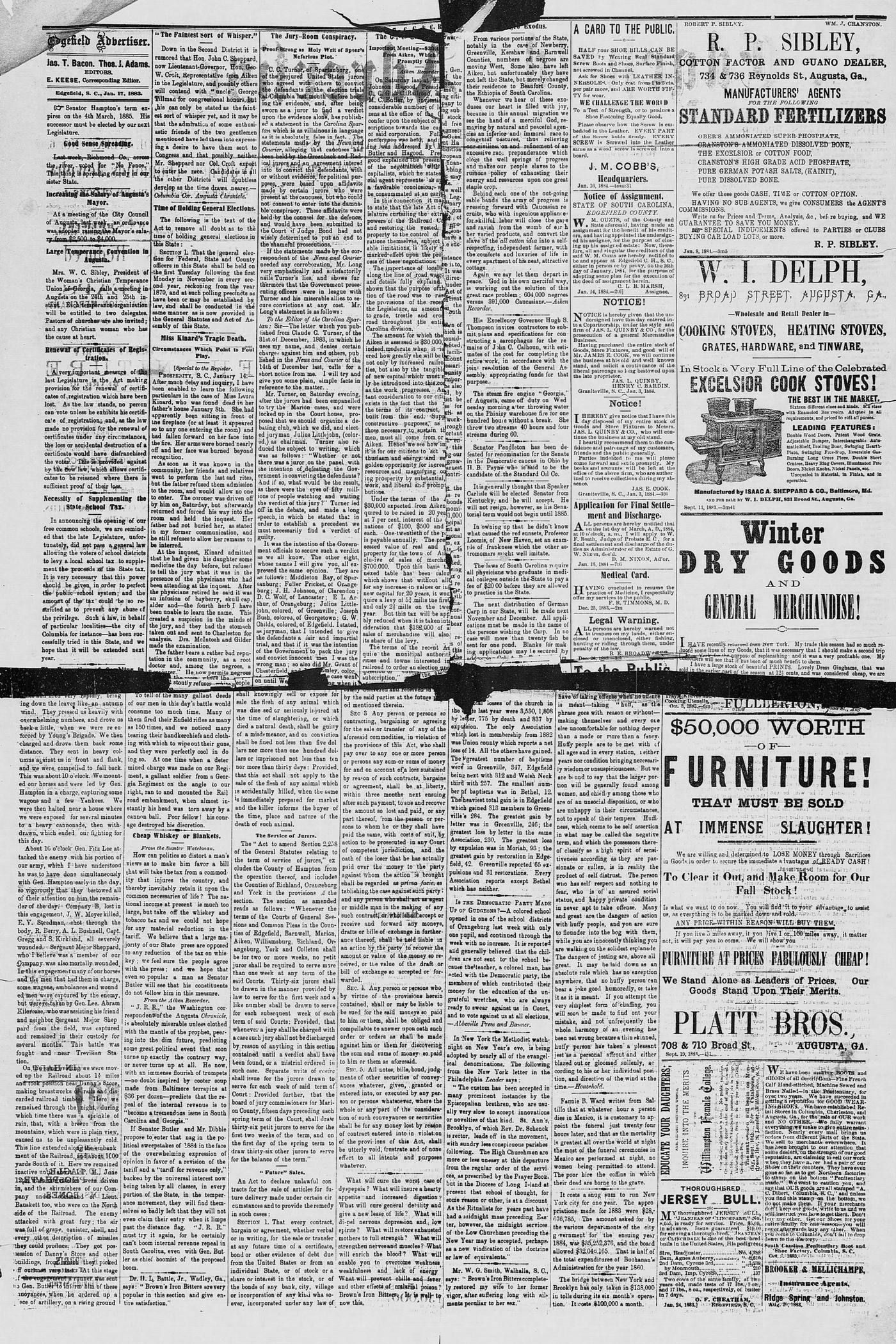
"Exodus"
The paper reports Black South Carolinians leaving for the West "in large numbers" — and insists there was "no political significance in this movement."
View full page →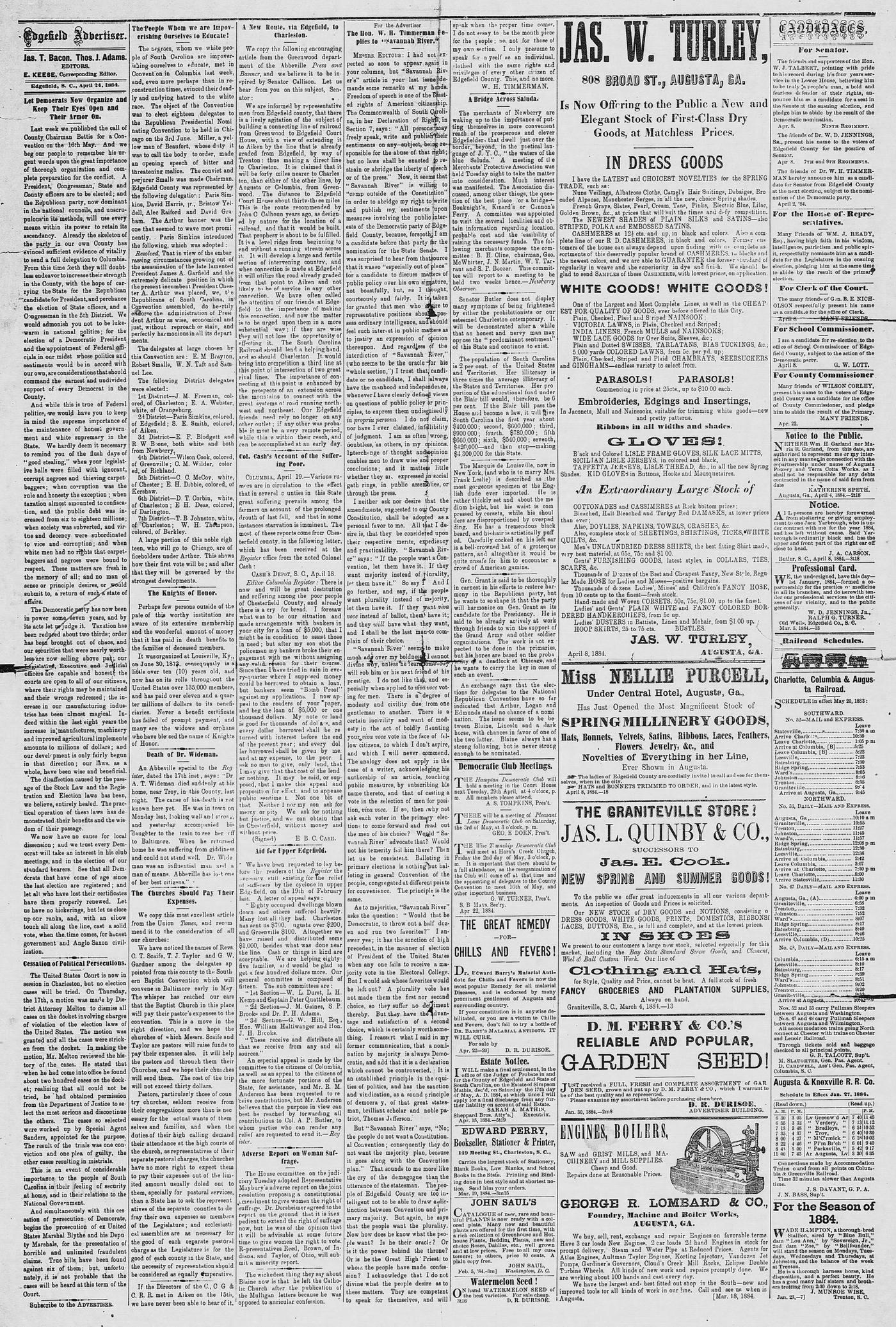
Defunding Black Education
From the era of the editorial "The People whom we are Impoverishing Ourselves to Educate!" — the campaign to make "the negro… pay for his own education."
View full page →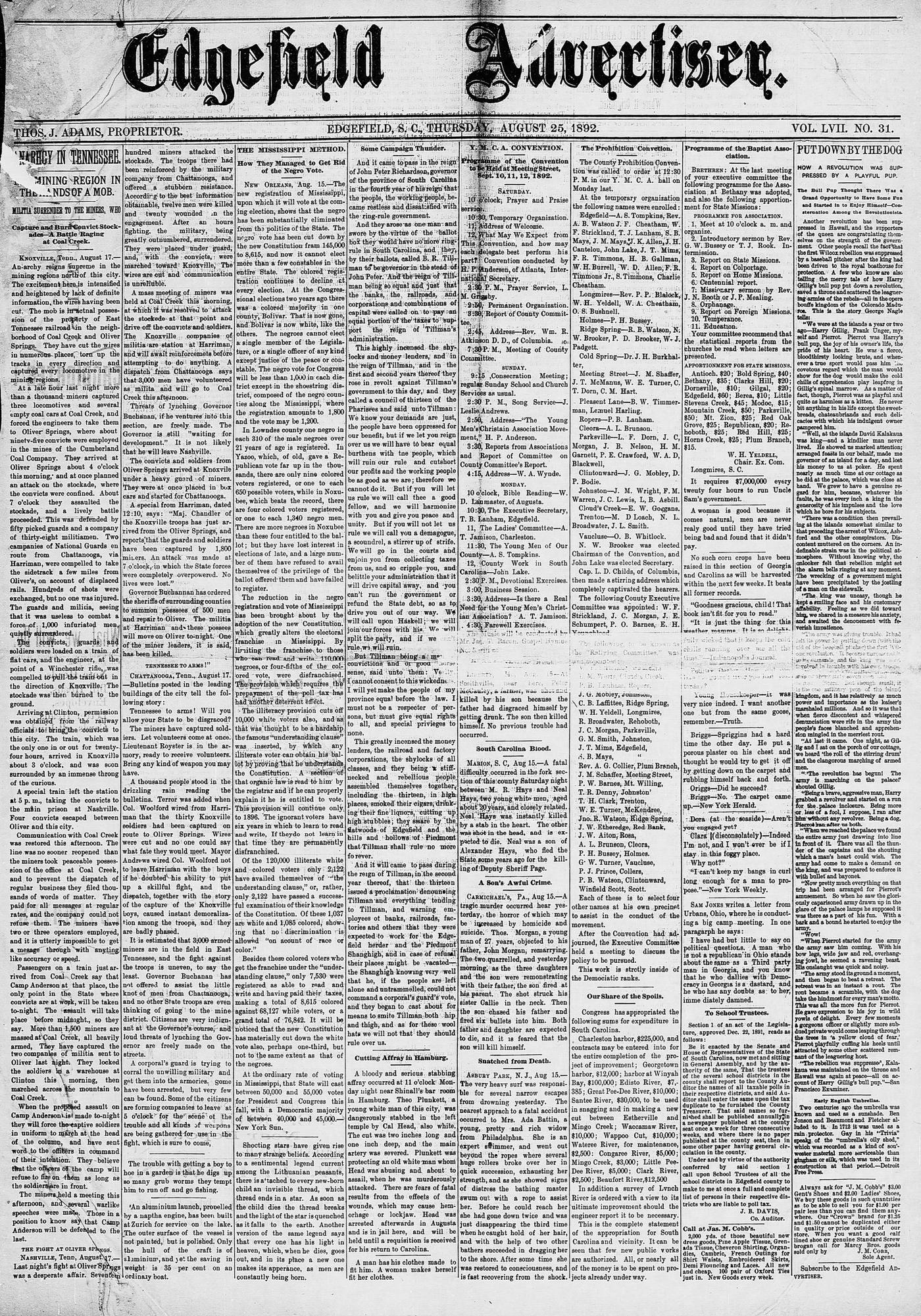
"The Mississippi Method"
The paper gloats over Mississippi's "understanding clause": of 70,000 eligible Black voters, only about 9,000 were allowed to register. A blueprint South Carolina would follow in 1895.
View full page →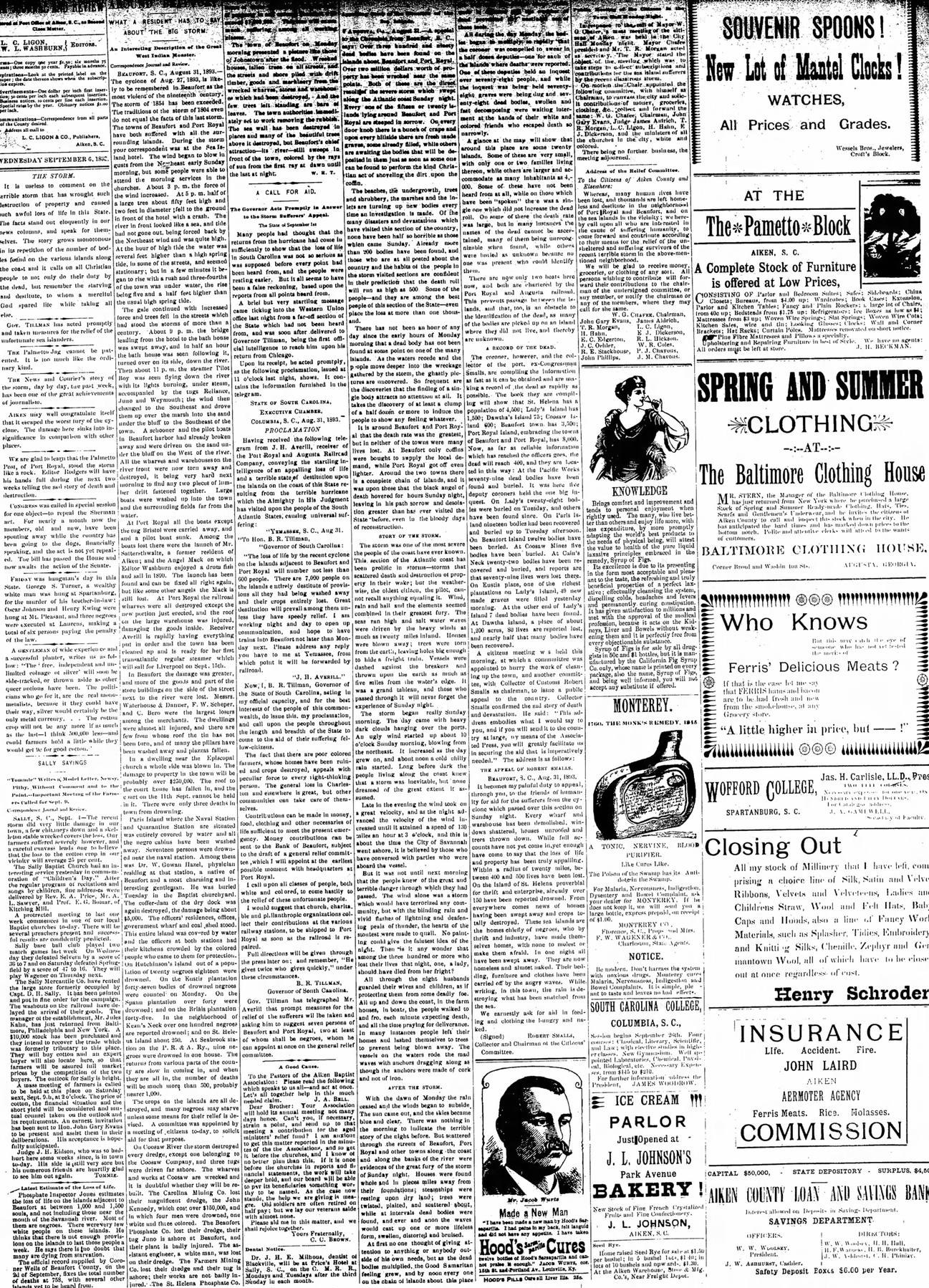
The Sea Islands Hurricane
"Many thousands of colored people on the islands adjacent to Beaufort and Port Royal… lost their lives." Bodies unburied, 7,000 destitute — Black communities bore the brunt and their needs were treated as secondary.
View full page →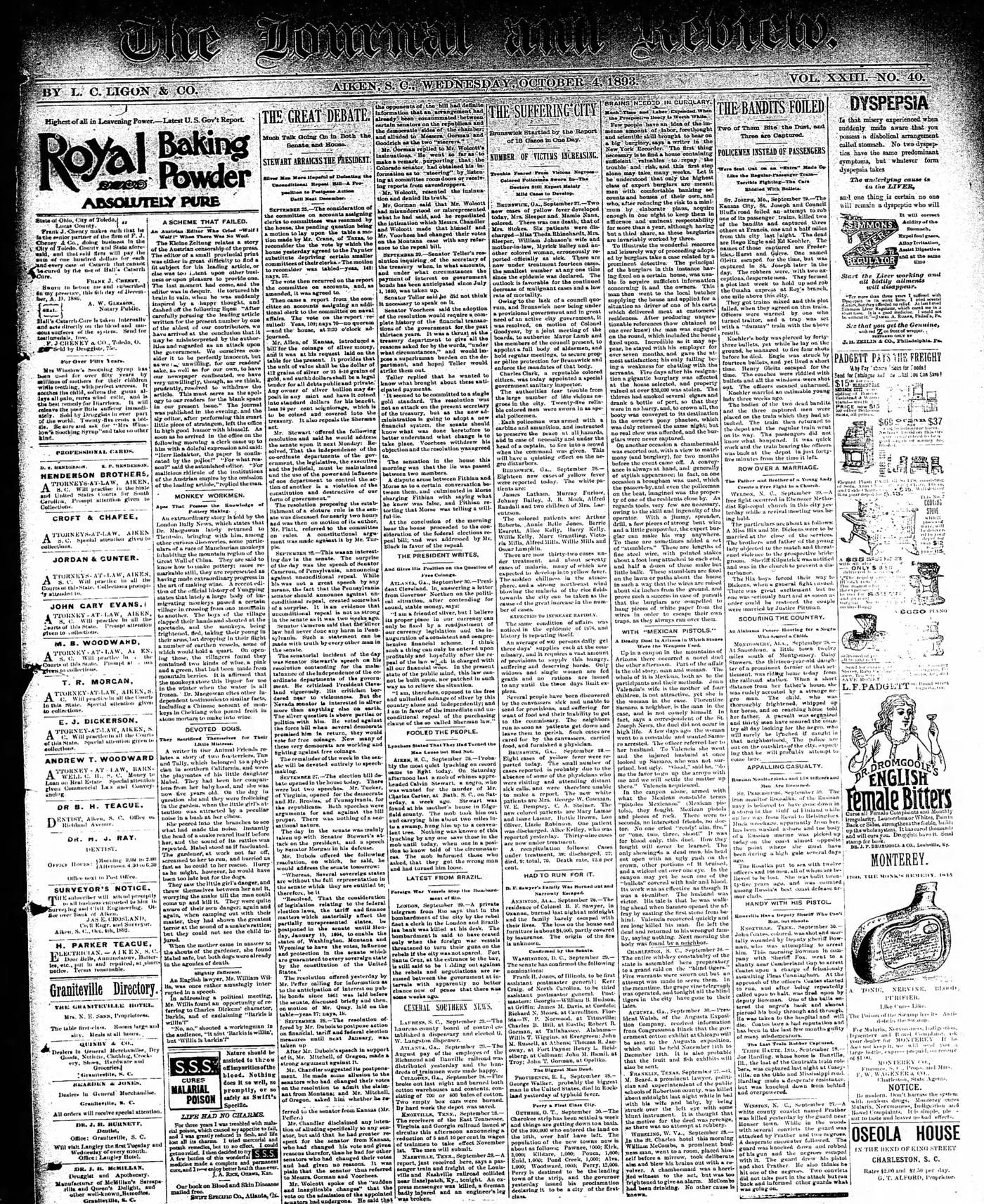
After the Storm
Continued hurricane coverage: "the crops are ruined and the cabins are blown away." Survivors faced starvation while relief lagged.
View full page →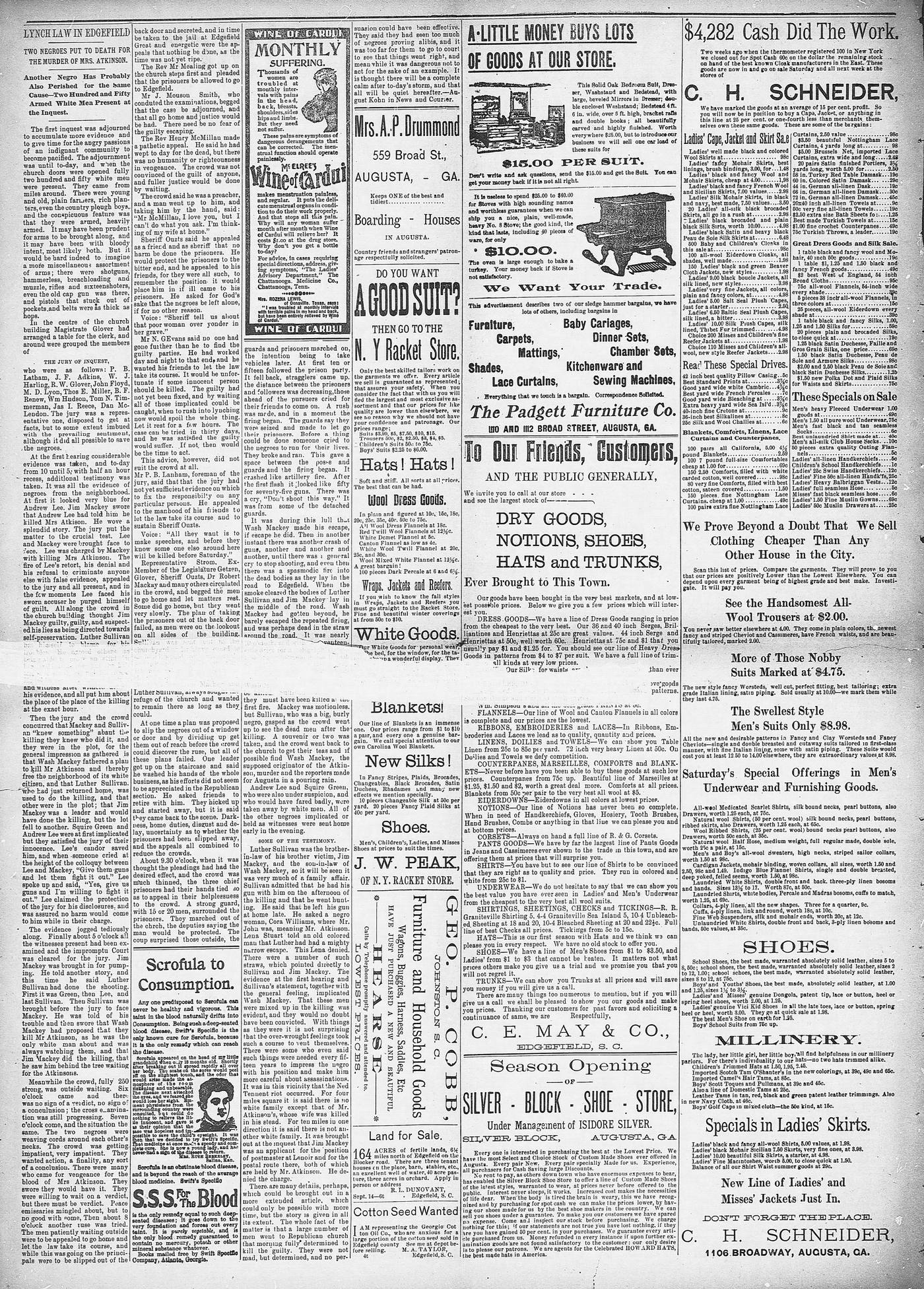
"Lynch Law in Edgefield"
The era's most chilling document: the organized firing-squad execution of John Mackey and Luther Sullivan, reported with approval as the act of an "indignant community" behaving "quietly and soberly."
View full page →📜 Read the article — full transcription: “Lynch Law in Edgefield”
Lynch Law in Edgefield
TWO NEGROES PUT TO DEATH FOR THE MURDER OF MRS. ATKINSON. — Another Negro Has Probably Also Perished for the Same Cause — Two Hundred and Fifty Armed White Men Present at the Inquest.
The first inquest was adjourned to accumulate more evidence and to give time for the angry passions of an indignant community to become pacified. The adjournment was until to-day, and when the church doors were opened fully two hundred and fifty white men were present. They came from miles around. There were young and old, plain farmers, rich planters, even the country plough boys, and the conspicuous feature was that they were armed, heavily armed. It may have been prudent for arms to be brought along, and it may have been with bloody intent, most likely both. But it would be hard indeed to imagine a more miscellaneous assortment of arms; there were shotguns, hammerless, breachloading and muzzle, rifles and sixteen-shooters, even the old cap gun was there, and pistols that stuck out of pockets and belts were as thick as hops.
In the centre of the church building Magistrate Glover had arranged a table for the clerk, and around were grouped the members of the jury of inquest, who were as follows: P. B. Latham, J. F. Adkins, W. J. Harling, R. W. Glover, John Floyd, M. D. Lyon, Thos. E. Miller, B. F. Renew, Wm. Hudson, Tom N. Timmerman, Jas. I. Reece, Dan McLendon. The jury was a representative one, disposed to get at facts, but to some extent imbued with the prevailing sentiment, although it did all possible to save the negroes.
At the first hearing considerable evidence was taken, and to-day from 10 until 5, with half an hour recess, additional testimony was taken. It was all the evidence of negroes from the neighborhood. At first it looked very blue for Andrew Lee. Jim Mackey swore that Andrew Lee had told him he killed Mrs. Atkinson. He wove a splendid story. The jury put the matter to the crucial test. Lee and Mackey were brought face to face. Lee was charged by Mackey with killing Mrs. Atkinson. The fire of Lee’s retort, his denial and his refusal to criminate anyone else with false evidence, appealed to the jury and all present, and in the few moments Lee faced his sworn accuser he purged himself of guilt. All along the crowd in the church building thought Jim Mackey guilty, and suspected his lies as being directed towards self-preservation. Luther Sullivan [several words illegible]…
[The prisoners were taken toward the] back door and secreted, and in time [to] be taken to the jail at Edgefield. Great and energetic were the appeals that nothing be done, as the time was not yet ripe. The Rev. Mr. Mealing got up on the church steps first and pleaded that the prisoners be allowed to go to Edgefield. Mr. J. Monson Smith, who conducted the examinations, begged that the case be adjourned, and that all go home and justice would be had. There need be no fear of the guilty escaping.
The Rev. Henry McMillan made a pathetic appeal. He said he had wept to-day for the dead, but there was no humanity or righteousness in vengeance. The crowd was not convinced of the guilt of anyone, and fuller justice would be done by waiting. The crowd said he was a preacher, and a man went up to him, and taking him by the hand, said: “Mr. McMillan, I love you, but I can’t do what you ask. I’m thinking of my wife at home.”
Sheriff Ouzts said he appealed as a friend and as sheriff that no harm be done the prisoners. He would protect the prisoners to the bitter end, and he appealed to his friends, for they were all such, to remember the position it would place him in if ill came to his prisoners. He asked for God’s sake that the negroes be left alone, if for no other reason. A voice: “Sheriff, tell us about that poor woman over yonder in her grave.”
Mr. N. G. Evans said no one had gone further than he to find the guilty parties… It would be unfortunate if some innocent person should be killed… Mr. P. B. Lanham, foreman of the jury, said that the jury had not yet sufficient evidence on which to fix the responsibility on any particular persons. He appealed to the manhood of his friends to let the law take its course and to sustain Sheriff Ouzts. A voice: “All they want is to make speeches, and before they know some one else around here will be killed before Saturday.”
Representative Strom, Ex-Member of the Legislature Getzen, Glover, Sheriff Ouzts, Dr. Robert Mackay and many others circulated in the crowd, and begged the men to go home and let matters rest. Some did go home, but they went very slowly. The plan of taking the prisoners out of the back door failed, as men were on the lookout on all sides of the building.
…It was during this lull that Wash Mackey made his escape, if escape he did. Then in another instant there was another crash of guns, another and another and another, until there was a general cry to stop shooting, and even then there was a spasmodic fire into the dead bodies as they lay in the road to Edgefield. When the smoke cleared the bodies of Luther Sullivan and Jim Mackey lay in the middle of the road. Wash Mackey had gotten beyond; he barely escaped the repeated firing, and was perhaps dead in the straw around the road.
…[No per]suasion could have been effective. They said they had seen too much of negroes proving alibis, and it was too far for them to go to court to see that things went right, and meanwhile it was dangerous not to act for the sake of an example. It is thought there will be a complete calm after to-day’s storm, and that all will be quiet hereafter. —August Kohn in News and Courier.
Transcribed from the Edgefield Advertiser, November 2, 1898, page 2. Original spelling and punctuation retained; bracketed words supplied where the scan is damaged. Note the reporter’s framing: the jury itself doubted the victims’ guilt, and the killing proceeded anyway, “for the sake of an example.”
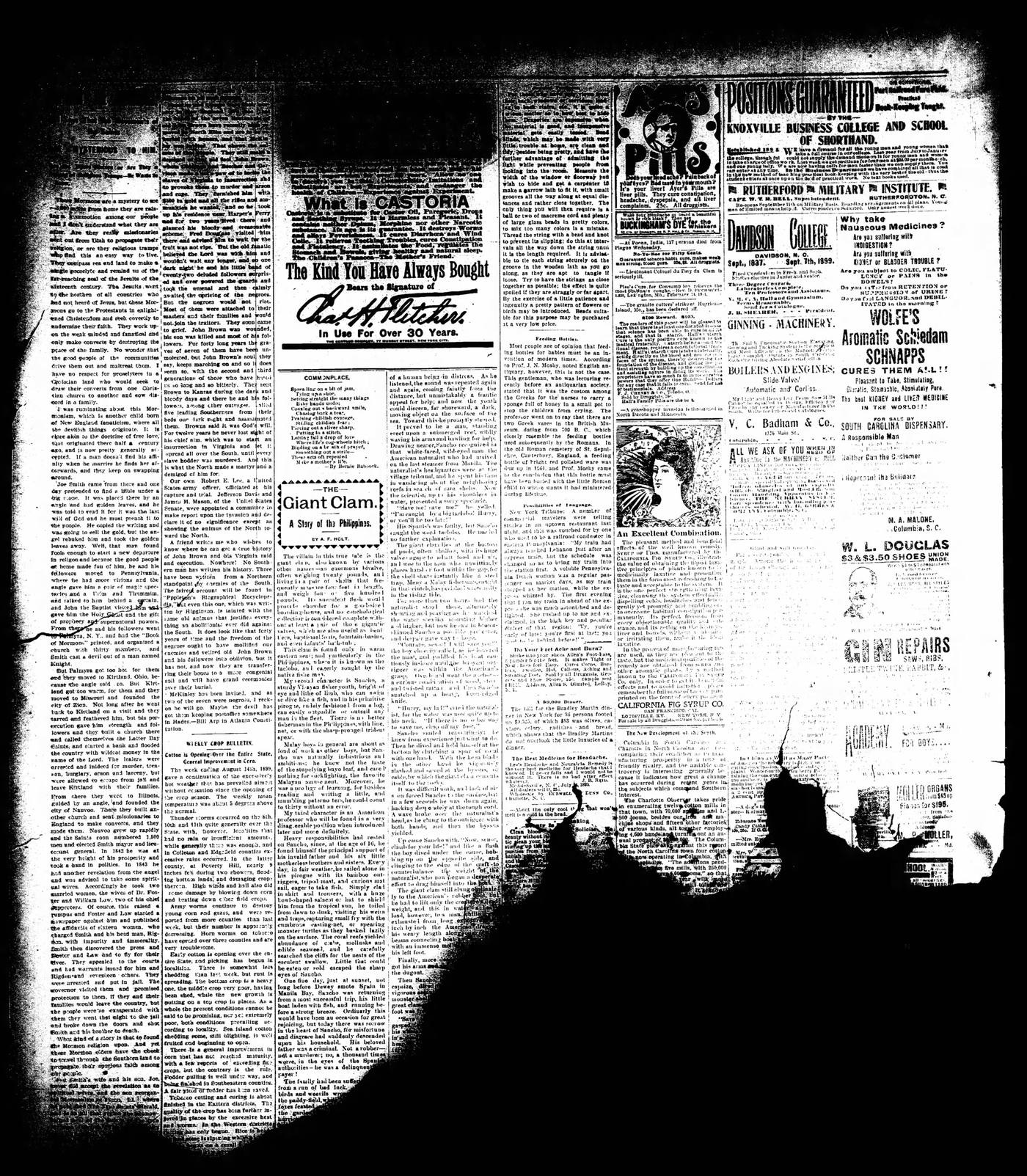
"Race War at Darien, Ga."
When Henry Delegal was arrested, Black residents rang the courthouse bell — a prearranged alarm — and mobilized, armed, to prevent his lynching. The press called self-defense a "race war."
View full page →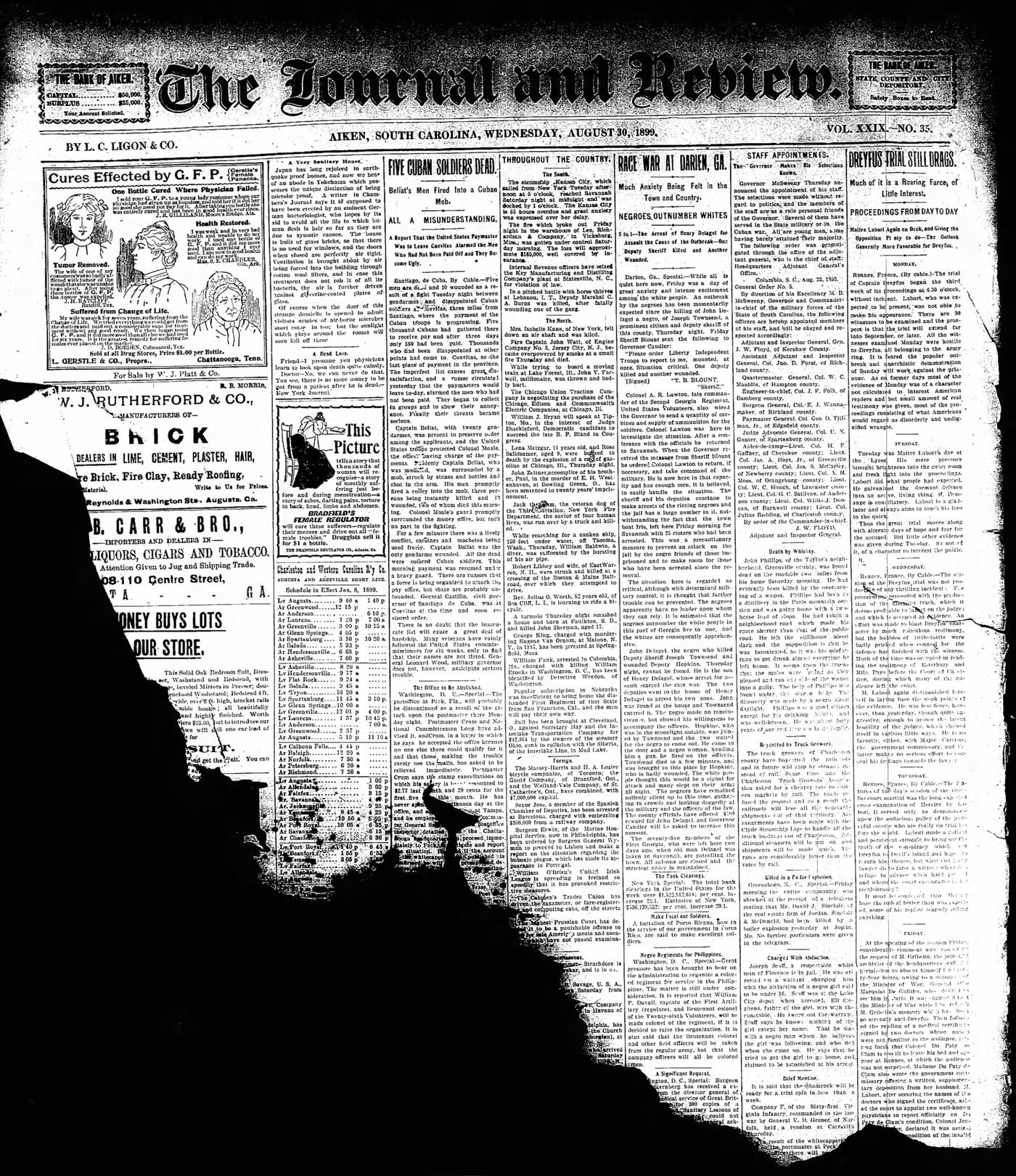
The Arrest of John Delegal
The "intelligent looking," "very well educated" preacher and teacher who tolled the bell is jailed in Savannah. He rang it, he said, so the community would "congregate as a matter of protection."
View full page →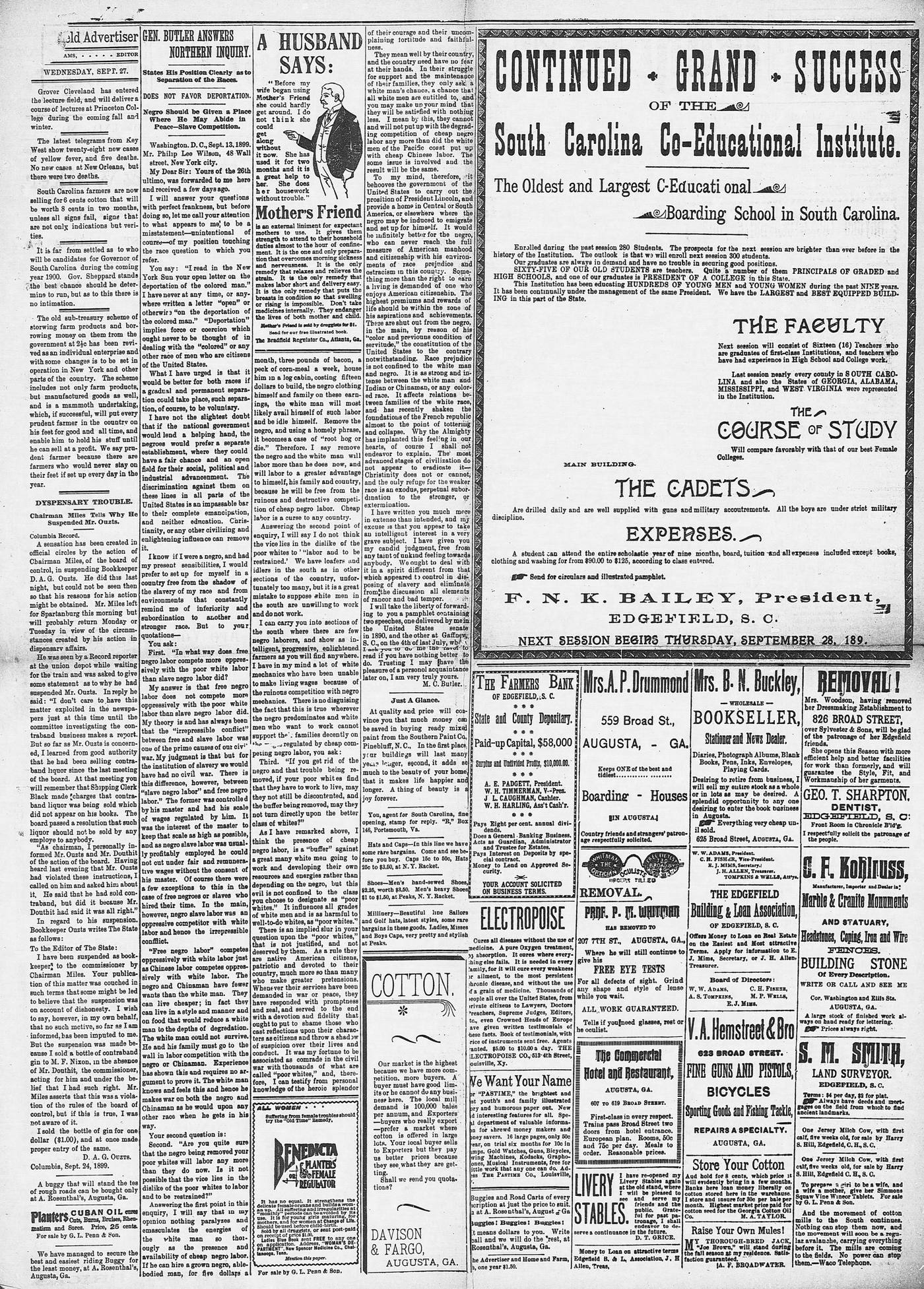
"Gen. Butler Answers Inquiry"
The leader of the Hamburg Massacre, now a former U.S. Senator, proposes government-funded removal of Black Americans — while admitting their labor was "the backbone of the Southern economy."
View full page →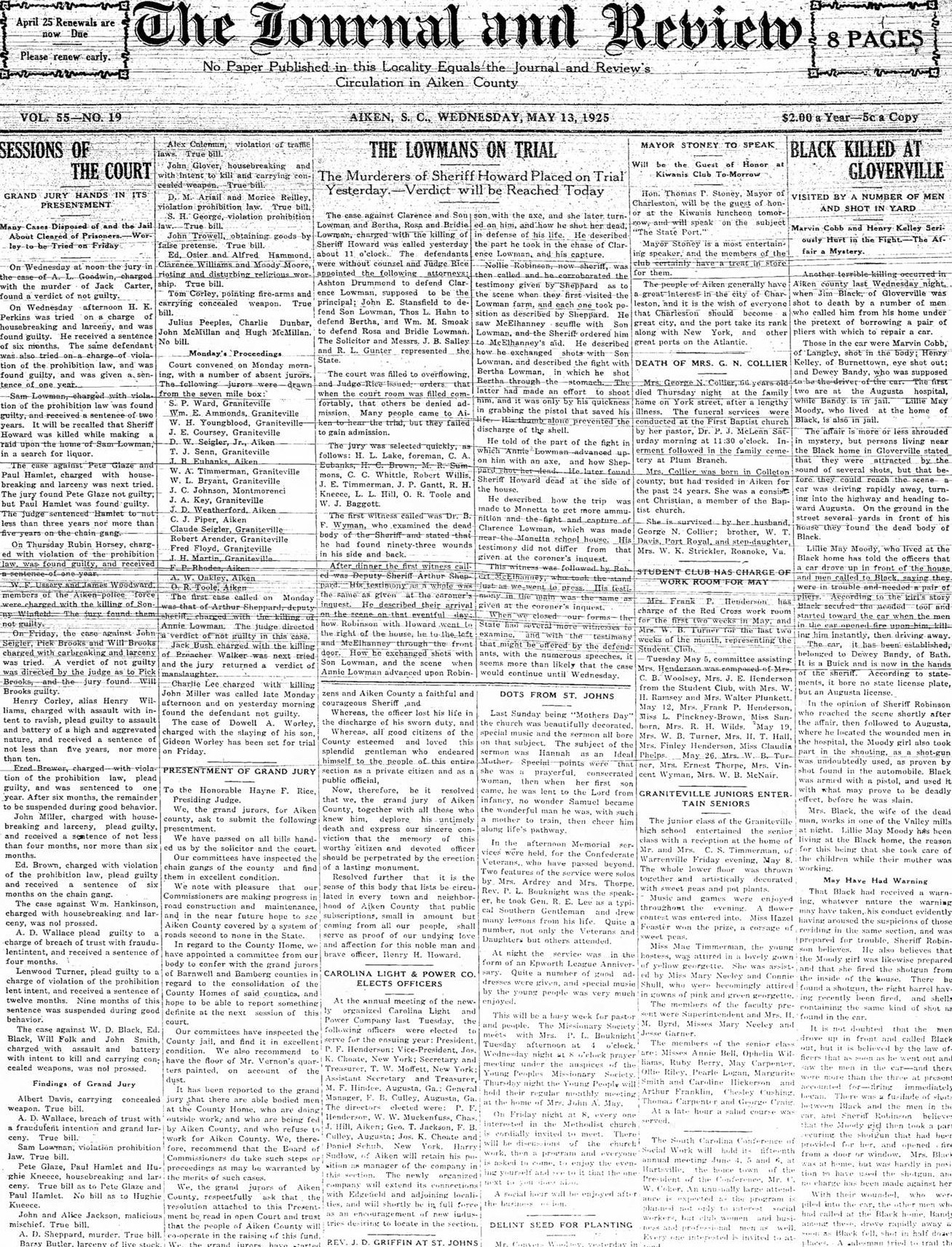
The Lowman Case Begins
Coverage from the aftermath of the deadly plainclothes raid on the Lowman family's tenant farm at Monetta — the event that set the county on the road to the pine thicket.
View full page →📜 Read the article — full transcription: “The Lowmans on Trial”
The Lowmans on Trial
The Murderers of Sheriff Howard Placed on Trial Yesterday.—Verdict will be Reached Today
The case against Clarence and Son Lowman and Bertha, Rosa and Bridie Lowman, charged with the killing of Sheriff Howard was called yesterday about 11 o’clock. The defendants were without counsel and Judge Rice appointed the following attorneys: Ashton Drummond to defend Clarence Lowman, supposed to be the principal; John E. Stansfield to defend Son Lowman, Thos. L. Hahn to defend Bertha, and Wm. M. Smoak to defend Rosa and Bridie Lowman. The Solicitor and Messrs. J. B. Salley and R. L. Gunter represented the State.
The court was filled to overflowing, and Judge Rice issued orders that when the court room was filled comfortably, that others be denied admission. Many people came to Aiken to hear the trial, but they failed to gain admission.
The jury was selected quickly, as follows: H. L. Lake, foreman, C. A. Eubanks, H. C. Brown, M. R. Summons, C. C. Whittle, Robert Willis, J. E. Timmerman, J. P. Gantt, R. H. Kneece, L. L. Hill, O. R. Toole and W. J. Baggott.
The first witness called was Dr. B. F. Wyman, who examined the dead body of the Sheriff and stated that he had found ninety-three wounds in his side and back.
After dinner the first witness called was Deputy Sheriff Arthur Sheppard. His testimony as a whole was the same as given at the coroner’s inquest. He described their arrival on the scene on that eventful day; how Robinson with Howard went to the right of the house, he to the left and McElhanney through the front door. How he exchanged shots with Son Lowman, and the scene when Annie Lowman advanced upon Robinson with the axe, and she later turned on him, and how he shot her dead, in defense of his life. He described the part he took in the chase of Clarence Lowman, and his capture.
Nollie Robinson, now sheriff, was then called and he corroborated the testimony given by Sheppard as to the scene when they first visited the Lowman farm, and each one took position as described by Sheppard. He saw McElhanney scuffle with Son Lowman, and the Sheriff ordered him to McElhanney’s aid. He described how he exchanged shots with Son Lowman, and described the fight with Bertha Lowman, in which he shot Bertha through the stomach. The latter had made an effort to shoot him, and it was only by his quickness in grabbing the pistol that saved his life. His thumb alone prevented the discharge of the shell.
He told of the part of the fight in which Annie Lowman advanced upon him with an axe, and how Sheppard shot her dead. He later found Sheriff Howard dead at the side of the house.
He described how the trip was made to Monetta to get more ammunition and the fight and capture of Clarence Lowman, which was made near the Monetta school house. His testimony did not differ from that given at the coroner’s inquest.
This witness was followed by Robert McElhanney, who took the stand just as we went to press. His testimony in the main was the same as given at the coroner’s inquest. When we closed our forms the State had several more witnesses to examine, and with the testimony that might be offered by the defendants, with the numerous speeches, it seems more than likely that the case would continue until Wednesday.
Transcribed from The Journal and Review, Aiken, S.C., May 13, 1925, page 1. Note what the article records without comment: a plainclothes raid in which officers shot Annie Lowman dead and shot Bertha Lowman through the stomach — reported entirely as officer testimony, with the surviving Lowmans on trial for their lives. The next year, after the Supreme Court threw out these convictions and an acquittal was directed, a mob took Bertha, Demon and Clarence Lowman from the jail and lynched them. The same front page carries a second headline: “Black Killed at Gloverville.”
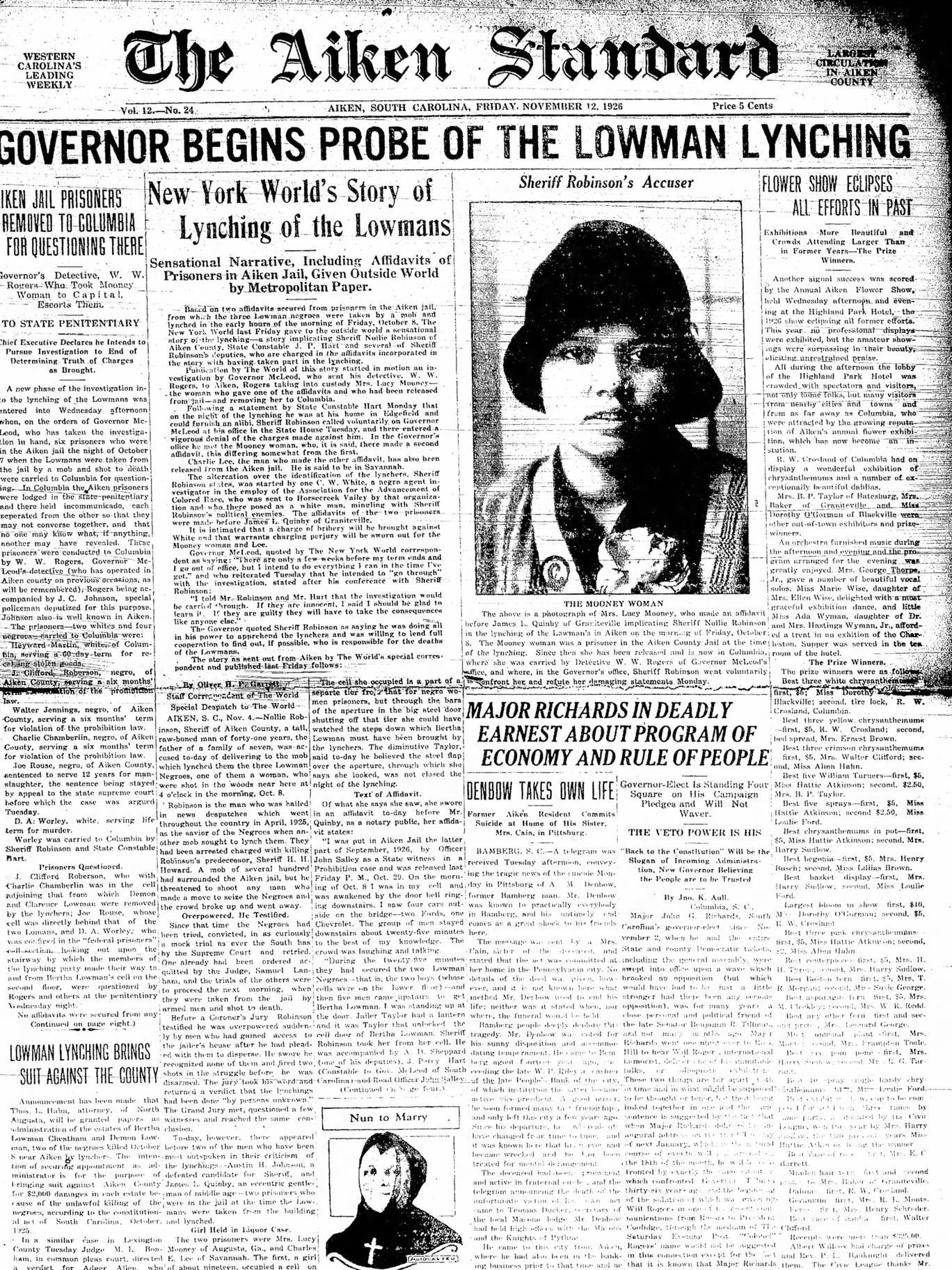
After the Lynchings
Printed weeks after the Lowman murders, as the NAACP's Walter White worked undercover in Aiken — and eighteen days before Emma Long's death. The grand jury would blame "parties unknown."
View full page →Newspaper pages digitized from the Edgefield Advertiser and Aiken Standard archives. Captions summarize the events these issues document, as analyzed in The Concatenation and the Edgefield source-note compilation. Click any page to view it at full size.