The Mortgage
On June 13, 1818, in the Edgefield District of South Carolina, a man named Harvey Drake mortgaged a seventeen-year-old boy to Eldred Simkins as collateral on a $600 note at the Bank of the State of South Carolina.
Mortgage of "a negro boy Dave" — June 13, 1818
The document does not use the boy's full name. It is not a birth record — it is a financial instrument. The bank needed collateral; the boy's body, his strength, his hands — the hands that would one day press words into wet clay and change the history of American art — were assigned a dollar value and pledged against a debt. He was, in the language of the ledger, an asset: worth $400 at the time of the mortgage.
He was not asked. No one who looked like Dave was ever asked anything in Edgefield in 1818.
Source: Mortgage, Harvey Drake to Eldred Simkins, Edgefield District, S.C., June 13, 1818 — the ancestral anchor of the entire documented lineage.
That sentence in the ledger is the beginning of everything. It is the first link in the chain — the record from which five generations of family history can be traced, from the Edgefield kilns to the museums of New York, Boston, and San Francisco.
Industrial Slavery in the Age of Fine Art
The Edgefield pottery district was one of the most sophisticated industrial operations in the antebellum South. The Landrum family — Abner, John, and Amos — pioneered an alkaline glaze using local wood ash and lime, the breakthrough that produced the glass-like sheen collectors prize today. The district's kilns at Pottersville, Landrumsville, and later the Lewis Miles operation produced massive quantities of stoneware for the plantation economy of the Deep South.
The labor force that made this possible was enslaved. Dave worked alongside other enslaved men whose names the records occasionally yield — Daniel, a turner. Abram. Harry. Baddler. They dug the kaolin, mixed the clay, and with the full strength of their bodies drew up jars so large most modern potters cannot replicate them.
Dr. Abner Landrum, founder of Pottersville and Dave's earliest enslaver in that community (through his business partnership with Harvey Drake), was an unusual figure: a physician, scientist, and Unionist who published a newspaper, the Edgefield Hive, out of Pottersville. At odds with his community, Landrum opposed anti-literacy legislation and "protected and fostered the freedom to read, write and worship for slaves and free blacks." It was in this world — a print shop and a pottery yard — that Dave's illegal literacy took root.
In 1834, South Carolina passed a law forbidding anyone from teaching enslaved or free people of color to read and write. Punishments for the enslaved caught reading or writing were savage. That is the year Dave began signing and inscribing his work.
The Rev. John Landrum Estate
When the Rev. John Landrum died, the machinery of the probate court did what it always did: it inventoried everything he owned. Mules and cart wheels, grind stones and spinning wheels, fodder and pine tables — and human beings, listed line by line among the goods and chattels, each with a price in the margin.
Inventory, Appraisement & Sale Bill of the Estate of Rev. John Landrum — January 22, 1847
The estate papers enumerate "18 likely Negroes" and note specifically that the estate includes "an excellent Stone Ware Turner." Excellent — a man valued not as a person but as a technical capability, documented alongside furniture and livestock. The inventory lists "1 Boy Dave" among the enslaved people of the estate.
The sale bill that follows records the auction: men, women, and children — "Man Dave," "Man Phil," "Boy Frank," "1 Woman Louisa & children," "1 Girl Caroline" — sold under the same heading as red hogs, wagon timber, and stacks of fodder. The buyers' names — B.F. Landrum, L.J. Miles, and others — are the names of the enslavers who would control the rest of Dave's working life.
Source: Estate of Rev. John Landrum, Inventory & Sale Bill, Edgefield District Probate Records, January 22, 1847. Dave's signing went silent from 1843 to 1849 — the years surrounding this estate, under B.F. Landrum, documented as the harshest period of his life.
These two records — the 1818 mortgage and the 1847 estate file — bracket Dave's enslavement in paper. Together they establish what the family's genealogical research would later confirm: the chain of custody that runs from "a negro boy Dave" through the Landrum and Miles potteries to the man the world now calls Dave the Potter.
The Poems
He began in 1834 — the year the anti-literacy law took effect, the year the state made his mind a crime.
The word is concatenation: from the Latin concatenare, to link together in a chain. By 1840 his voice had found its stride:
Wher the oven bakes & the pot biles.1840
In three lines Dave lists the animals of the working plantation world, names himself in the same grammatical structure, and then names the place where he actually lives — the oven, the fire, the kiln, where clay is transformed into something that outlasts the people who made it. This is what I am to the law. And this is where I actually live.
Friendship to all — and every nation.1850s — written when the domestic slave trade was tearing families apart with industrial efficiency
Though it is called lucre trash.1857 — the year of the Dred Scott decision
He wrote until at least 1862, when the world was finally breaking open. Then, as far as the record shows, he stopped. Perhaps the messages had been delivered. When emancipation came, he chose a surname — Drake — the name he carried from the mortgage document into freedom.
His marks carried meanings beneath the words as well: the X and the cross-in-circle known locally as the "Landrum cross" echo the Bakongo cosmogram (dikenga), the West African symbol of the cycle of life, death, and the spirit world — a covert language of African identity hiding in plain sight on plantation stoneware.
"Beneath his magic touch"
Dave was not invisible in his own lifetime. In May 1859, shortly after Dr. Abner Landrum's death, the Edgefield Advertiser published a nostalgia piece recalling Old Pottersville — and its most vivid memory was of watching Dave work:
Children made Saturday pilgrimages to watch him at the wheel. And when Dr. Landrum's obituary ran, Dave answered the next day in the only medium he had — inscribing a jar on April 14, 1859: "Over noble Dr. Landrum's head / May guardian angels visit his bed."
The Household on Shaws Creek
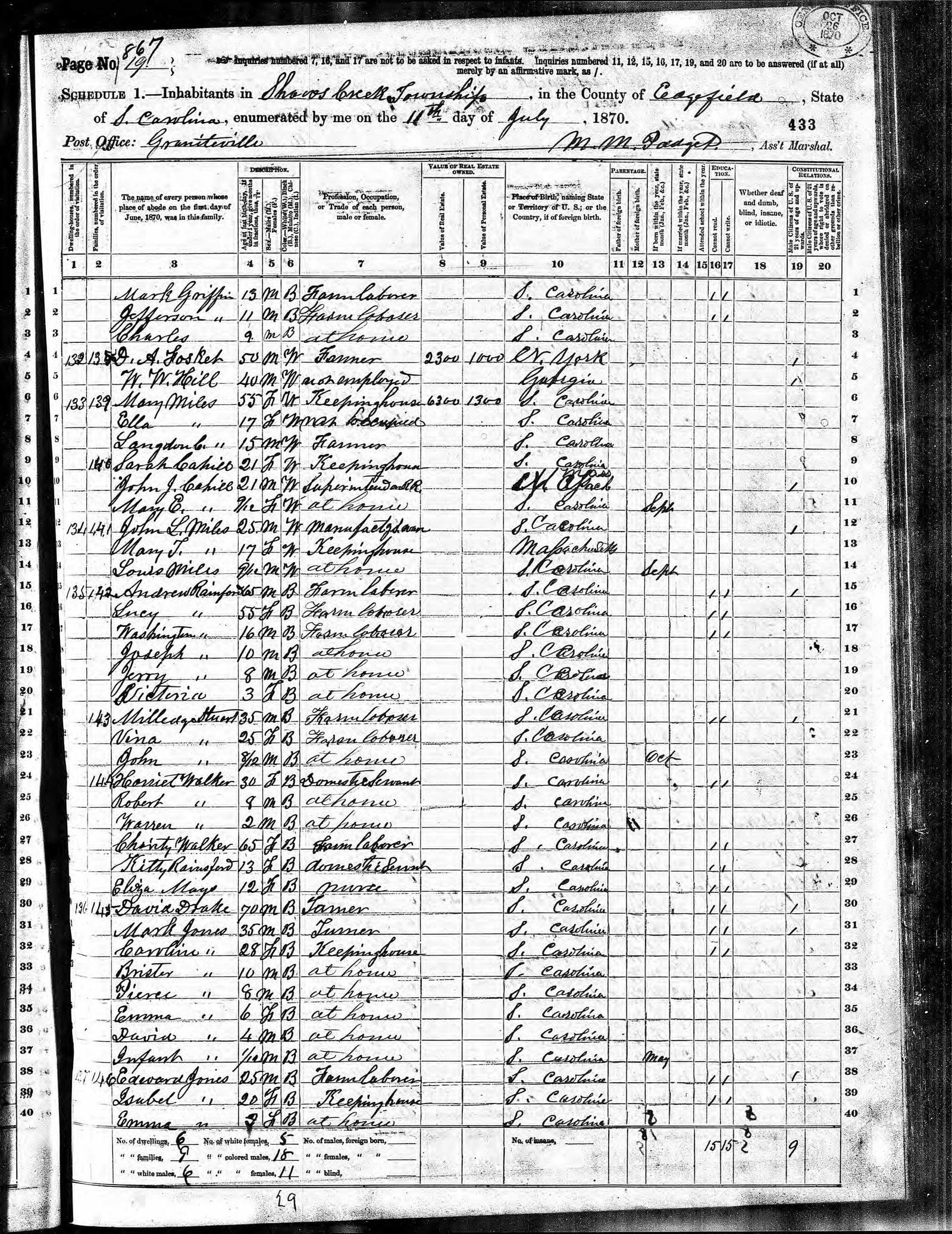
The 1870 Federal Census — the first in which Dave appears as a person rather than a tally mark — finds him in Shaws Creek Township, Edgefield County: David Drake, age 70, Black, "Turner." In the same household: Mark Jones, 35, also a turner, and Caroline Jones, 28 — née Miles, carrying the name of Lewis Miles, the enslaver whose initials appear beside Dave's on his jars. With them, the children: Brister, 10. Pierce, 8. Emma, 6. David, 4. An infant.
Caroline Miles: Dave's daughter. The link. She is the woman through whom everything that follows flows.
Dave died sometime in the 1870s — very old for a man who had worked the way he worked — in the same county where his daughter was raising children, and where the Red Shirts were already riding. What his family inherited is the subject of the next part of this story.