An act of treason, disguised as a signature
To his enslavers, Dave was laboring property, valued for his ability to turn forty-gallon storage jars with astonishing precision. But with a blunt stylus and a steady hand he carved a different reality into the alkaline glaze. His signature — a bold, cursive Dave — was a revolutionary assertion of personhood by a man the law defined as a commodity. He knew that paper decays and bills of sale are lost, but kiln-fired stoneware becomes an indestructible witness. Each dated jar is a diary entry that cannot be erased — and, as his descendants would learn nearly two centuries later, a message left deliberately for them.
On a jar of 1857, he asked the question that governs this whole archive:
Friendship to all — and every nation”
Two centuries later, the records answered him.
The clay that carried the message
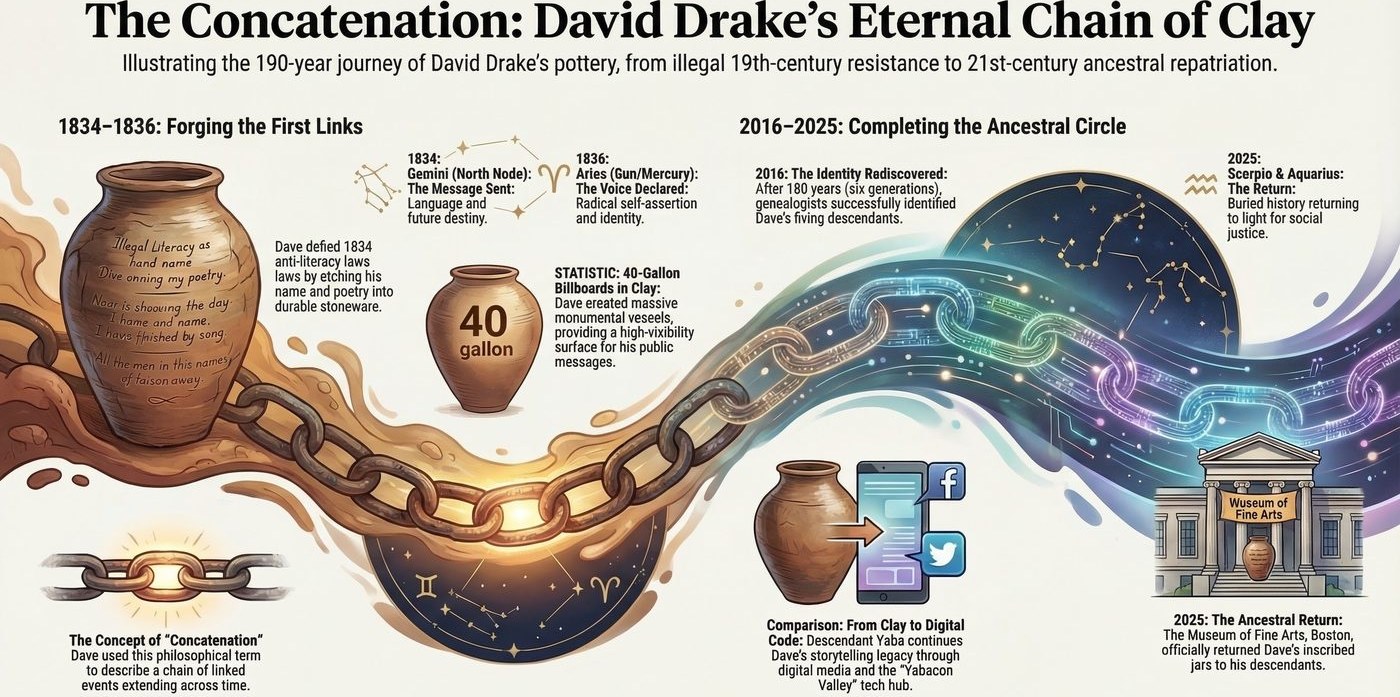
His marks carried more than English. The “cross” motif on his vessels read to enslavers as Christian piety — and to the enslaved community as the Bakongo cosmogram, the dikenga, mapping the Four Moments of the Sun: birth, maturity, death, and the ancestral realm. In the clay itself — kaolin, the white clay of Congolese protective tradition — the vessels connected Edgefield to West and Central African practice. The pots were containers for lard and grain, and containers for memory.
Every known inscription, 1834–1862
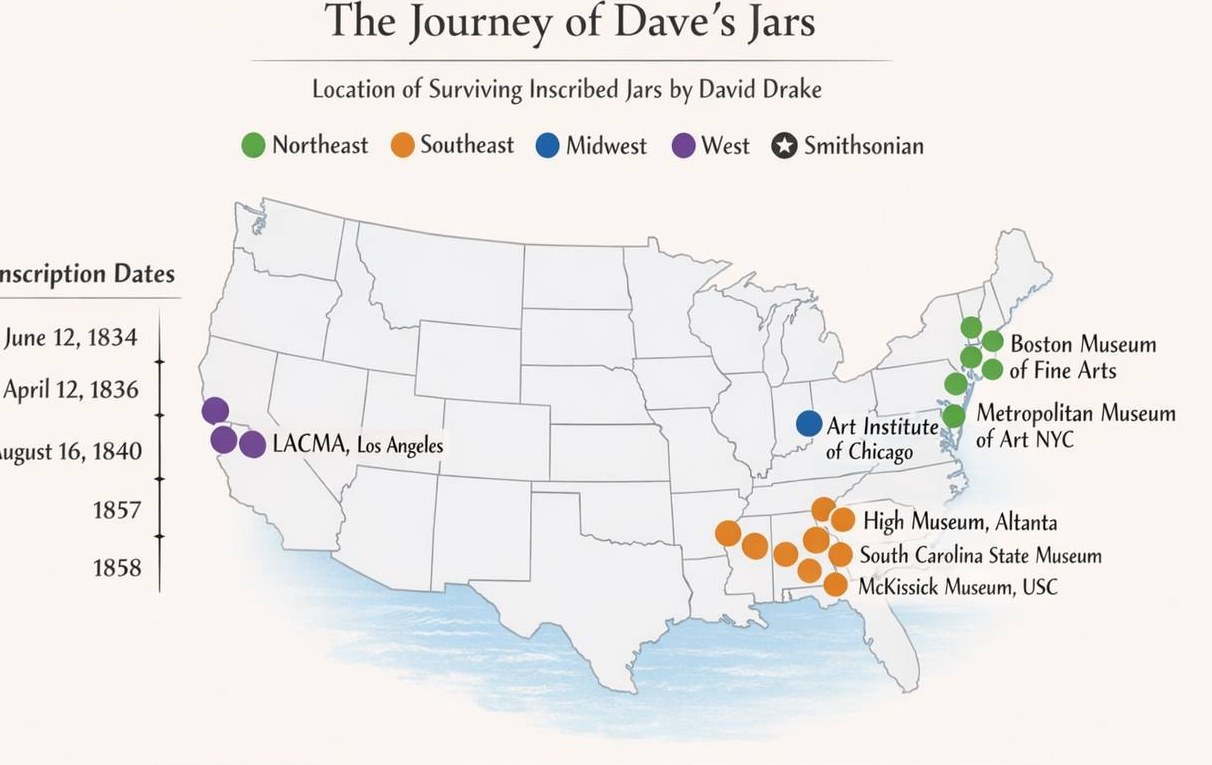
Verses and words in chronological order, from the first known inscribed vessel to the last dated jar of the Civil War years. Where a vessel’s present home has been verified, it is noted. Highlighted cards mark the two philosophical words — Concatination and Catination — Dave’s own names for the chain.
surely this jar will hold 14
hard work to make big Jars
all our cows is in the bogs —
there they shall ever stay
till the buzzards take them away
When I shot off the lions jaw
see all you can: & nothing you’ll loose
while we both are at fishing
Though they are dangerous; to our soul
wher the oven bakes & the pot biles
Dearest Miss, spare me a kiss
Friendship to all — and every nation
though its called — lucre trash
volca[n]ic mountain, how they burge
Lads & gentlemen: never out walks
For lard or tar
fill it up it will never turn
It will never — never — rott
fill it with silver then you’ll have plenty
pack it full of fresh meat — then light candles
Scot will be there to get a peace, —
This jar is to Mr Segler who keeps the bar in orange burg
For Mr Edwards a Gentleman —
who formly kept Mr thos bacon horses
in the west are plenty of — bears
then I felt the need of — grace
Lots of people after its over
How they will grieve
If you do not listen at the bible you’ll be lost —
May guardian angels visit his bed
unto you all I fill in — — cline
blest we were, when peter saw the folded sheets
for making lard enuff
Dave Baddler
hold sheep goat and bear
Dave & Baddler
to blow the fife = and beat the drum
then I felt, the need of grace
then carry it a round to the Indian chief
If you don’t repent, you will be lost
Verse texts follow the compilation in Jill Beute Koverman, ed., I made this jar… Dave: The Life and Works of the Enslaved African-American Potter Dave (McKissick Museum, University of South Carolina, 1998), as reproduced by the National Humanities Center, with the research chronology of the Descendants of Dave initiative. Spelling and lineation follow the vessels.
The man behind the verses
The poems are one half of the story. The records that priced, counted, and finally freed the poet — and the family that carried his blood out of South Carolina without knowing his name — are the other. Continue to Dave’s Life & the Estate Files, or open the document archive.