The Research Reports
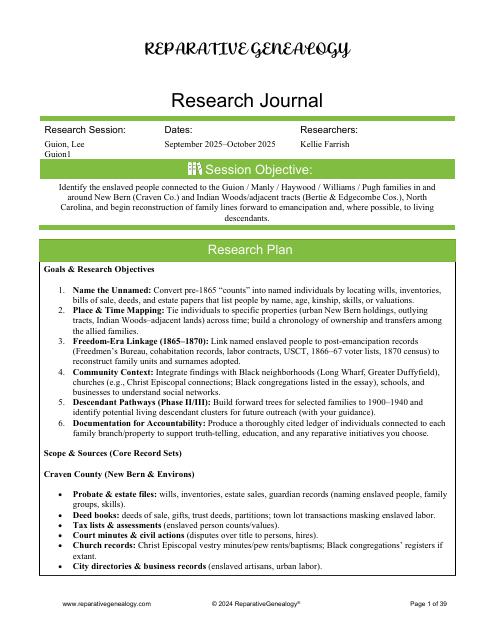
Two sessions, two reports. Session I (December 2025) surveyed the whole Guion network of New Bern — the enslaved families of the 1842 probate and the earlier deeds, traced forward into the censuses of freedom. Session II (June 2026) took one name from that inventory — Hannah, ten years old, $350 — and reconstructed her entire life. Read the summaries below and download the complete reports and journals.
Hannah Guion, c. 1831–1899 — Comprehensive Report
The Session II report, From the New Bern Ledger to the Stars: Hannah's full biography across twenty sections, from the 1842 inventory through Lincolnton, Freedman Town, Charlotte, Salisbury, the 1899 will, and the dynasty that followed.
Session I in Brief — The Guion Network
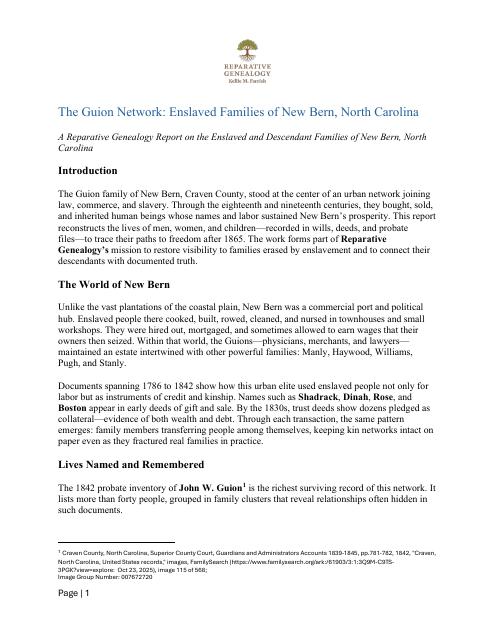
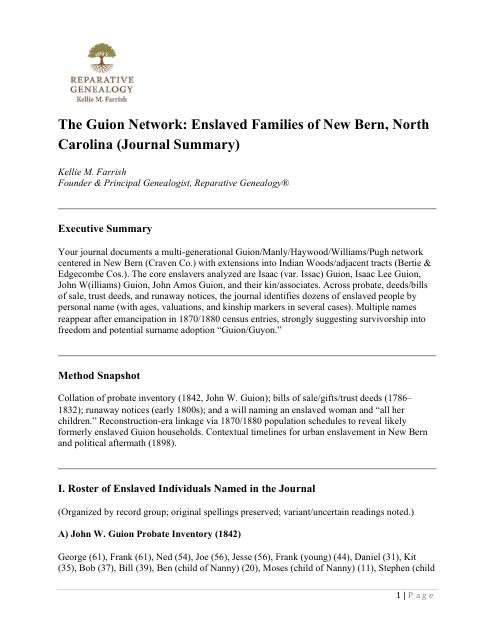
The Guion family of New Bern, Craven County, stood at the center of an urban network joining law, commerce, and slavery. Documents spanning 1786 to 1842 show an urban elite — physicians, merchants, and lawyers intertwined with the Manly, Haywood, Williams, Pugh, and Stanly families — using enslaved people not only for labor but as instruments of credit and kinship. The 1842 probate inventory of John W. Guion is the richest surviving record of this network: more than thirty people, grouped in family clusters that reveal relationships often hidden in such documents — Nanny with three generations around her; Sukey with seven named children; Eliza with Harriet and Cicero; elders George, Frank, Ned, Joe, and Jesse; and at the bottom of the list, Hannah, aged 71, valued at $0.
After emancipation, fragments of these families surface in the 1870 and 1880 censuses: Edward Guion, a 93-year-old gardener who may be the “Ned (54)” of 1842; Frank Guion, 85 and then 91; Moses Guyon of Bladen County, blind yet working as a railroad pump laborer, his age matching the child of Nanny's line. Such continuities — of names, trades, and family patterns — transform a ledger of property into a lineage of survivors. The report closes with the survey's reparative purpose: each recovered name becomes a door through which descendants may walk, connecting family memory with documentary truth.
Session II in Brief — From the Ledger to the Stars
The comprehensive report reconstructs Hannah's life from the surviving record and sets it inside the world she actually inhabited: the mercantile port of New Bern, the courthouse town of Lincolnton, and the rising New South cities of Charlotte and Salisbury. Its twenty sections cover the New Bern world and Sukey's family; Haywood W. Guion's life and migrations; the 1842 fracture; the Lincolnton years and the 1860 genealogical bridge; Sherrill's history and “the colored folks”; the Shuford creditor's sale that founded Freedman Town; Hannah's Lot No. 3 and the Lander conveyance; the complete 1880 Freedman Town register; the Guion–Shuford credit machinery; the Charlotte years, from the 1870 household of trust through the Johnston will that left her $100 “for years of faithful service”; the Salisbury purchases beside Livingstone College; the 1899 will and her sudden death; and the dynasty that followed — the Harrises, the Stewarts, and the Blufords, from the A.M.E. Zion pulpit to the Kansas City Call to the Space Shuttle.
The report states facts plainly where the documents speak plainly, identifies inferences as inferences, and gathers its open questions honestly — the 1860 New Bern fair premium, Elsie's paternity, the several Cicero Guions — rather than smoothing them over.