Haywood W. Guion: The Patriarch Isolated
No life in this record bears more directly on Hannah's than that of Haywood Williams Guion (c. 1813–1876), the New Bern–born attorney who inherited her in 1843 and fathered her younger daughter, Maria Elizabeth. Schooled at Bingham's Academy and the University of North Carolina, he practiced law at Lincolnton from the late 1830s, designed the old courthouse, helped found St. Luke's Episcopal Church, presided over the Wilmington, Charlotte & Rutherford Railroad (1854–65), sat on the state Military Board of 1861, and stood as a Confederate elector. His migrations — New Bern to Lincolnton to Charlotte — traced the exact path Hannah was forced to follow. The war broke his fortune: by 1870 he was insolvent, his lots conveyed to a creditors' trustee, and he died of paralysis at Charlotte on 19 July 1876 — two wards from where Hannah and Maria had been enumerated in 1870.
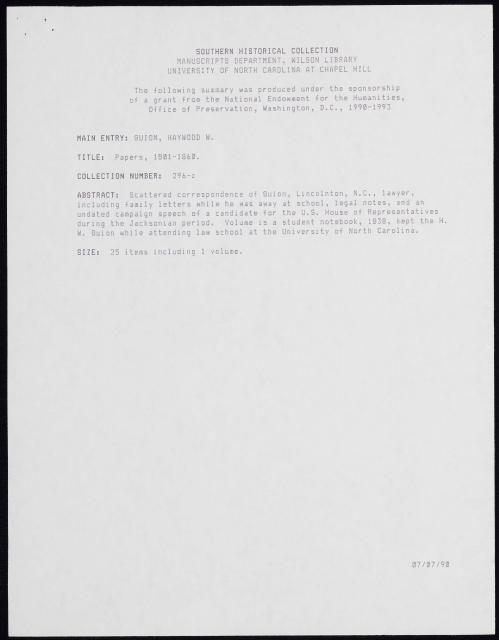
The Haywood W. Guion Papers (SHC 296-z) — Original Scans
The surviving personal papers of Haywood Williams Guion, Southern Historical Collection, UNC Chapel Hill: schoolboy letters, the 1833 Malta letter from his brother John A. Guion, legal papers, and the certified 1844 copy of the Robert Simonton will that later binds him to Hannah's 1870 Charlotte household. Large file (64 MB).
The 296-z Papers — Full Project Transcription
Complete transcription of the Haywood W. Guion Papers, made June 2026: the letters, accounts, and legal instruments that reconstruct his path from New Bern schoolboy to Lincolnton attorney.
Identity Memorandum: One Haywood W. Guion
The research memo resolving the identity of the 296-z attorney with the Haywood W. Guion of the 1842 probate — the son of John W. Guion of New Bern who received ten-year-old Hannah in the 1843 division — and guarding against conflation of the several Guion men.
See Also
The Comet (1869)
The anonymous cosmological treatise his obituaries attributed to him — filed with the Histories.
The Trust-Deed Machinery
Guion as fiduciary of insolvent estates — the same machinery that later subdivided the Shuford land into Freedman Town.
The 1870 Household
The Simonton will in his papers, and the family whose daughters Hannah kept in Charlotte.